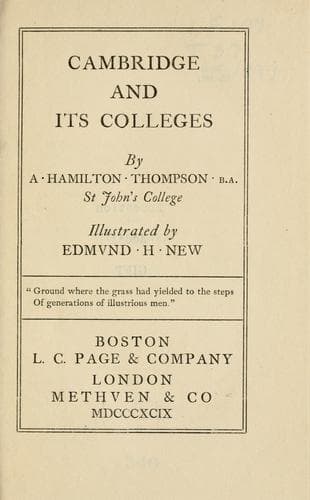
Cambridge and Its CollegesThompson, A. Hamilton (Alexander Hamilton)
History
Cambridge and Its Colleges
Thompson, A. Hamilton (Alexander Hamilton)
University of Cambridge
activities, too, others have grown. The energies of the University have
been expanded in every direction. The multiplication of open scholarships
and prizes, the University Extension system, the foundation of colleges
for women, are only a few of the ways in which her influence has been
doubled throughout Great Britain. And in all this surely her founders
and benefactors have full recompense for their labours—in the love which
the University excites in her sons and in the contribution of each member
to the corporate action of the whole body.
II
THE UNIVERSITY CHURCH
[Illustration: Sᵗ. Mary the Great]
The Church of St Mary-by-the-Market, better known as Great St Mary’s, is,
as it stands at present, a fine example of the latest style of English
architecture. Two churches, when it was built, had already occupied the
site. The first, entirely parochial, was probably built in Norman times,
but was burned down in 1290. By that time, however, the University then
emerging from its embryonic state into actual life, had begun to use it
for its meetings. The church formed, as it were, the earliest Senate
House. After the fire, which, like so many medieval catastrophes, was
put down to the Jews, the structure was renewed in the style of the
period. We find that Thomas de L’Isle, Bishop of Ely, granted a license
for the consecration of the High Altar in 1346; and that, in 1351, the
consecration took place under his successor, Simon of Langham. The
chancel still retains some features of this remodelled church. In
the year after the consecration, the Gild of the Blessed Virgin Mary,
parishioners of this church, joined with the Gild of Corpus Christi in
the foundation of Corpus College; and, in 1342, Edward III. had granted
the advowson of St Mary’s to the scholars of King’s Hall. In this way it
happened that, at the subsequent rebuilding of the church, the town, the
University, and the college were equally concerned in it. The present
building was begun in 1478, when John Morton was Bishop of Ely, and
the main structure, roughly speaking, belongs to the period between
that year and 1491. It is supposed that, during this reconstruction,
the services were held in the chancel, which, presumably, was merely
remodelled in the perpendicular manner. The character of the nave is,
for its period, strikingly excellent, and the work is not unlike that at
St Nicholas, Lynn, and other fine churches in the eastern counties. The
surface-ornament in the spandrils of the chancel-arch and nave arcade
is exceptionally good, and the depression of the arches is very slight.
Characteristically, the piers have no capitals, but a small shaft with
a plain capital carries the innermost moulding. But the best feature
of the interior is the high, plain clerestory, from which the church
originally received its principal light. This forms, as it were, a wall
of glass running along the upper storey of the church. Its lowest part is
panelled, forming a kind of mock triforium.
Public-domain text, read in full here on John Shaqi.
Reviews
Reviews
No reviews yet
Be the first to share your thoughts on this work.
Join the Discussion
Join the discussion
Sign in to leave a comment or review.
Sign InorCreate an account