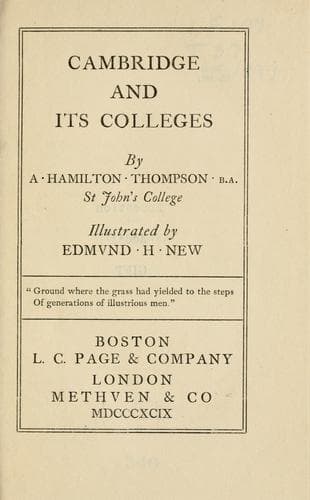
Cambridge and Its CollegesThompson, A. Hamilton (Alexander Hamilton)
History
Cambridge and Its Colleges
Thompson, A. Hamilton (Alexander Hamilton)
University of Cambridge
On the whole, there are few
more stately churches of the date in England.
Although this nave was completed in 1491, it was not ready for service
till 1519, when the nave was seated and the Great Rood suspended from the
chancel-arch. Meanwhile, the tower had been begun in 1491, and progressed
very slowly. In 1515 it was at a standstill and had a thatched roof.
The west window, however, which, considering that it belongs to Henry
VIII.’s reign, is surprisingly good Gothic, was glazed by 1536. After
this time a certain amount of work went on, and the tower was carried up
to the string-course. In 1576, Sir Walter Mildmay gave twenty tons of
freestone towards the building, which was employed in erecting a somewhat
heavy Italianised porch at the west end. This, with its great pediment
and the clock above it, filled up the space between the buttresses and
reached up to the sill of the west window. Sir Walter Mildmay promised
other materials for the completion of the tower by a stone spire. This
never took place, and, in 1593, the parish decided to add a final storey
on their own account, which was completed in 1596. This storey, with
its octagonal corner-turrets and debased windows, is nevertheless in no
violent contrast to the work below. In 1608, the turrets were completed
and stone balls were placed upon the pinnacles by Robert Grumbold, to
whom we owe the balls on Clare Bridge.
The last internal addition to the church was the magnificent rood-loft,
finished in 1523. It extended not only across the chancel-arch, but
across the northern arch, leading to the Chapel of St Andrew, and the
southern, leading to the Chapel of Our Lady. These chapels were further
separated from the chancel by parclose-screens. The contract states
that the rood-lofts at Thriplow, south of Cambridge, and at Gazeley,
between Newmarket and Bury St Edmunds, were the models used for this
structure. It must have been something like the great rood-lofts which
still exist in Devonshire and parts of Norfolk. In the middle, below
the rood-beam and facing the choir, was the University pulpit. But this
screen, with its elaborate furniture, its “yomages,” candles and gilding
did not have a long existence. It was destroyed by Archbishop Parker,
that sworn enemy of rood-lofts, in 1562. However, during the Laudian
revival, in 1640, another chancel-screen was erected, part of which
remains across the chapel of St Andrew. Its fine composition and carving
are characteristic of the Stewart era. Another and even better screen
of a somewhat earlier date is to be seen in the church of Tilney All
Saints, near Lynn. However, this screen perished in its turn, not at the
hands of the zealot Dowsing, who destroyed as much as he could, but under
the gentle influence of Georgian restorers. It appears that, after the
Reformation, the University sermon became more of an institution than
it had been, and was no longer preached to the chancel. Great St Mary’s
Public-domain text, read in full here on John Shaqi.
Reviews
Reviews
No reviews yet
Be the first to share your thoughts on this work.
Join the Discussion
Join the discussion
Sign in to leave a comment or review.
Sign InorCreate an account