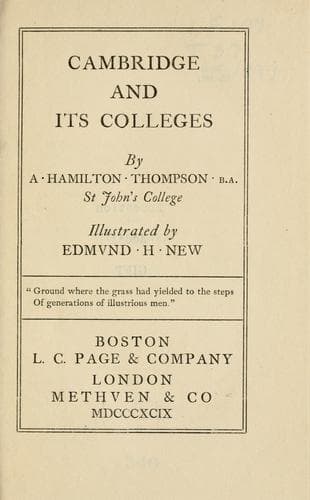
Cambridge and Its CollegesThompson, A. Hamilton (Alexander Hamilton)
History
Cambridge and Its Colleges
Thompson, A. Hamilton (Alexander Hamilton)
University of Cambridge
Too late to stay the hand of the spoiler, the Gothic revival has
nevertheless done much for Peterhouse. Mr Gilbert G. Scott in 1870
rebuilt the Hall and Combination Room and incorporated in them the
remains of the medieval Master’s Lodge, which had been long ago
superseded by the comfortable brick house just across Trumpington Street.
Good, unassuming and appropriate work in themselves, these buildings are
further decorated with some very successful stained glass by the late
Sir Edward Burne-Jones and Mr William Morris. The bright oriel of the
Hall is especially beautiful, and the small figures of poets and of the
good women of Chaucer’s dream in the windows of the comfortable parlour,
share, with the chapel glass, the impartial admiration of the visitor. It
is satisfactory to think that this historical college has received some
compensation for all the damage inflicted on it.
* * * * *
In 1281 Hugh de Balsham, Bishop of Ely, founded St Peter’s College.
The reign of Edward I. is the date from which our universities derive
their organisation, and in many other ways it marks an epoch in
English history. Walter de Merton, Bishop of Rochester, had, seventeen
years before, founded Merton College at Oxford.[2] It was therefore
emulation which, to a certain extent, inspired Hugh de Balsham in his
new departure. He was a native of Cambridgeshire: his native place is
about ten miles distant from Cambridge, on the confines of Essex; and
he had probably received his education in one of the numerous religious
houses which filled the Cambridge of that period. As Bishop of Ely, and
therefore as titular abbot of the monastery, he had much to do with the
monastic institutions of the town, and it was only natural that, with
Walter de Merton’s example before his eyes, he should wish to make his
name famous in the same way. He lived just long enough to see the college
established and in a fair way to success, with a master and fourteen
scholars in residence. His successors at Ely continued his favours to
the college, and during the next century we find the names of Bishops
Simon Montague, Thomas de L’Isle, Simon Langham and John de Fordham among
the benefactors. It is interesting to note how purely local University
education must have been at first. Although the first two masters of
Peterhouse appear to have been natives of distant parts of England, the
names of most of the masters during the fourteenth century recall the
neighbouring fenland. Roger of Mildenhall, Ralph of Holbeach, William of
Whittlesea, Richard of Wisbech, John of Bottisham, all are natives of
Cambridgeshire or the counties immediately adjoining. Thomas of Barnard’s
Castle, who became master in 1400, takes us further north, and he is the
last of the list who derives his surname from his native place.
Public-domain text, read in full here on John Shaqi.
Reviews
Reviews
No reviews yet
Be the first to share your thoughts on this work.
Join the Discussion
Join the discussion
Sign in to leave a comment or review.
Sign InorCreate an account