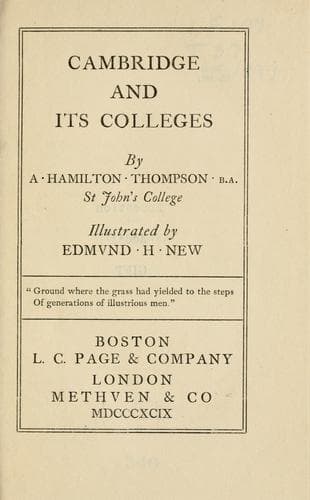
Cambridge and Its CollegesThompson, A. Hamilton (Alexander Hamilton)
History
Cambridge and Its Colleges
Thompson, A. Hamilton (Alexander Hamilton)
University of Cambridge
The early history of Peterhouse is concerned chiefly with its buildings.
Under the rule of John Holbrook (1418-1431) and during the long
mastership of Dr Thomas Lane (1431-73) the college assumed a definite
shape. The old buildings north of it belong to Holbrook’s mastership. It
took in the house of the Friars of the Sack, which existed on part of its
site, and thus set a precedent which was followed almost universally—the
substitution of learned foundations for monasteries and convents. The
Peterhouse of that day, substantially the building of our own time, was
scarcely in Cambridge. St Peter’s Church lay north of it, and was itself
just outside the Trumpington or South Gate of the town. It had given its
name to the college, and was used as its chapel from the earliest period.
About the beginning of Edward III.’s reign, the church was pulled down,
and the present beautiful church of St Mary’s the Less was built on its
site, the college still continuing to use it as their place of worship.
We may assume that the scholars were required to assist at mass every
morning and at the parochial mass on Sundays, and that they formed, as it
were, the choir, using the chancel stalls. They entered the church by the
passage and staircase which still exist south of the chancel.
No famous names occur in connection with the college before the
Reformation. The early sixteenth century produced a good number of
benefactors, and Hugh de Balsham’s original provisions were considerably
amplified. In 1553 Andrew Perne became master. His fame is largely
local, but he is a very significant figure in an age chiefly remarkable
for the strength of its religious convictions. His mastership begins
at the end of Edward VI.’s reign, and lasted for thirty-six years. He
combined with it the Deanery of Ely, and showed great sagacity in the
tenure of both offices. During Mary’s reign, he was Chancellor of the
University, and under his auspices the burning of Bucer’s and Fagius’
remains took place. However, although this somewhat unnecessary act of
vengeance might have stamped his opinions, he seems to have veered at
the accession of Elizabeth with great suppleness, and to have trimmed
his sails to the royal wind up to the day of his death. The wits of
the University made his accommodating policy their butt, and, with the
heavy wit of the day, coined the verb _pernare_, which signified “to
turn one’s coat.” Perne, although he possibly merits some contempt,
made nevertheless a very good use of his unscrupulous comfort. I have
already mentioned his additions to the college. He also originated that
water-supply which is now so ornamental a feature in certain parts of the
town. The broad gutters along which streams run down Trumpington Street
for most of the year were not constructed till after his death, but it
was he who first suggested that healthy water might be brought from the
neighbouring Gogmagog Hills.
Public-domain text, read in full here on John Shaqi.
Reviews
Reviews
No reviews yet
Be the first to share your thoughts on this work.
Join the Discussion
Join the discussion
Sign in to leave a comment or review.
Sign InorCreate an account