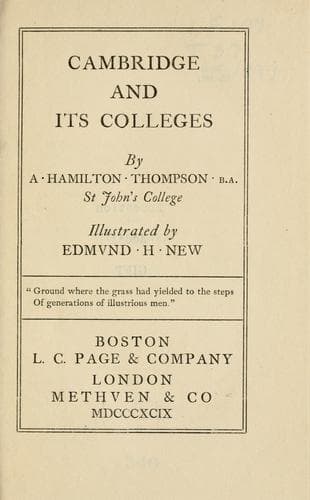
Cambridge and Its CollegesThompson, A. Hamilton (Alexander Hamilton)
History
Cambridge and Its Colleges
Thompson, A. Hamilton (Alexander Hamilton)
University of Cambridge
Clare has, on the whole, no very momentous annals. Hugh Latimer,* the
famous Bishop of Worcester, was a member of this foundation, and, as
Fellow of Clare, preached in St Edward’s Church. Until the foundation
of King’s, the chapel of Clare was the parish church of St John the
Baptist, which stood on the south side of the college. After St John’s
had been removed to make way for King’s, Clare shared the possession of
St Edward’s Church with Trinity Hall. Latimer, however, is by no means
the typical theologian of Clare. The worthies of the college are chiefly
religious, and, a century after, it contributed to the Laudian revival.
When James I. paid his visit to Cambridge, he was entertained with a
comedy at Clare. The name of the piece was “Ignoramus” and its author was
Mr George Ruggle, one of the society. It satirised the civil law, which
was then doing its best to oust the canon law, and James, who always
had a keen sympathy for the obsolete, was hugely delighted. Some years
before, Ruggle had satirised the townsfolk in a play called _Club-Law_,
to which the Corporation were invited. The absence of good feeling which
marked such an invitation explains the “town and gown rows” common at
this period.
A less festive spirit than George Ruggle was Nicholas Ferrar,* who
appears at Clare about the same time. Ferrar ranks with Herbert and
Crashaw as the third of the mystics and pietists whom Cambridge sent out
during the seventeenth century. He became famous as the head of what he
called the “Protestant Nunnery.” It was established at Little Gidding, an
out-of-the-way village in Huntingdonshire, and consisted of Ferrar, some
members of his family, and some near relations, who devoted themselves to
contemplation and works of piety. The neighbourhood of Little Gidding to
Cambridge was probably felt in the University, and there is the strongest
probability that men like Cosin and Andrewes came over from Cambridge
very often, and went into retreat, as we say, with Ferrar. A man of this
type was the great Peter Gunning,* Fellow of Clare and Lady Margaret
Professor of Divinity. In 1661 he exchanged his offices for those of
Regius Professor and Master of Corpus, which he soon left for St John’s.
While the new court of Clare was building, the Commonwealth came, and
with it the mastership of Ralph Cudworth. This profound thinker held the
chair of Hebrew with his mastership, and continued to hold it till his
death in 1688. He is certainly one of the most extraordinary figures
of his age at Cambridge, but his history and that of the band whose
leader he was, belong more properly to the annals of Christ’s. Almost a
contemporary of Cudworth’s was Archbishop Tillotson,* who, at this date
in his career, was a Puritan, like many of the youth at Cambridge. He
later found his true vocation in the Church of England, and his sermons
have achieved a greater fame than Cudworth’s abstract treatises, although
their merits are perhaps less.
Public-domain text, read in full here on John Shaqi.
Reviews
Reviews
No reviews yet
Be the first to share your thoughts on this work.
Join the Discussion
Join the discussion
Sign in to leave a comment or review.
Sign InorCreate an account