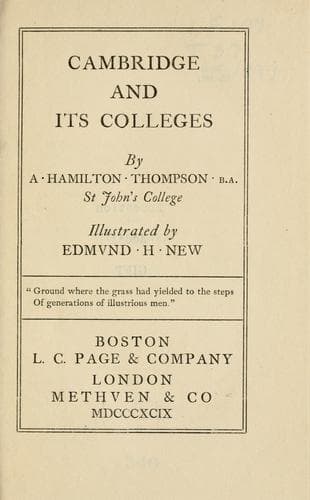
Cambridge and Its CollegesThompson, A. Hamilton (Alexander Hamilton)
History
Cambridge and Its Colleges
Thompson, A. Hamilton (Alexander Hamilton)
University of Cambridge
The northern face of the court is
good, solid, ugly Queen Anne work, which has, of late years, been spoiled
rather than improved. On this side is the Hall with great sash-windows,
which the famous Clare creeper does not succeed in hiding. The Chapel is
a plain building of excellent proportions. Internally, it has most of the
virtues and faults of a Georgian college chapel: the domical antechapel
is an original feature. On the whole, Clare, which covers less ground
than most colleges, is, architecturally, among the best; but it is a pity
that all was not carried out in the style of the western side, which is
almost unrivalled in any country, considering its date. The celebrated
bridge, not unlike the Kitchen Bridge at St John’s, belongs to the reign
of Charles I. and is therefore contemporary with the older part of the
court. It is well set off by its charming surroundings. The architect of
this bridge, completed in 1640, was Robert Grumbold, who was master-mason
to the college, and worked at Great St Mary’s as well as at Clare.
[Illustration: Clare Bridge]
* * * * *
The idea of Clare Hall originated with Richard de Badew, who, in 1326,
while Chancellor of the University, founded a small college called
University Hall. The first master of this new foundation was Walter of
Thaxted. But, in the twelfth year of its existence, the college was
burned down. Usually the present college dates its foundation from 1338,
when the rebuilding began, but the actual date at which Elizabeth de
Burgh took over the foundation was 1342. She was daughter and coheir
of Gilbert, Count of Clare, Hertford and Gloucester. Clare lies on the
border of Suffolk and Essex, and the college was essentially an Essex
colony. Two of the early masters, Walter of Thaxted and William of
Radwinter, came from villages in the same part of the county, and their
names, occurring not far apart, argue a certain feeling in favour of
natives of the district. There was for a long time a tradition that
Clare Hall was the Soler Hall of Chaucer’s _Reve’s Tale_, but it is not
necessary to suppose that Chaucer had any particular college in his mind.
His use of the epithet “great” may point to Clare and distinguish it from
the numerous hostels which were then springing up in Cambridge; but there
can be no certainty on the point. Chaucer merely borrowed a tale from
Boccaccio and put it into English dress, without any particular accuracy
of detail.
Public-domain text, read in full here on John Shaqi.
Reviews
Reviews
No reviews yet
Be the first to share your thoughts on this work.
Join the Discussion
Join the discussion
Sign in to leave a comment or review.
Sign InorCreate an account