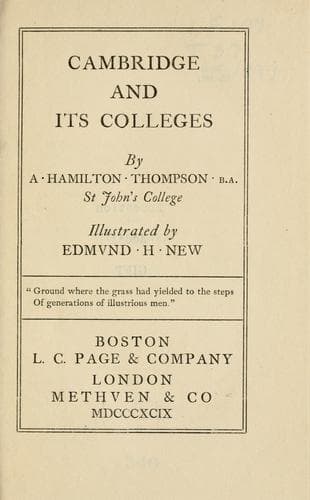
Cambridge and Its CollegesThompson, A. Hamilton (Alexander Hamilton)
History
Cambridge and Its Colleges
Thompson, A. Hamilton (Alexander Hamilton)
University of Cambridge
Pembroke escaped Essex and Wilkins, but it can hardly be congratulated
on what it has acquired instead. The south side of the old court has
perished; the quaint two-storied building which contained the Hall and
Library, has disappeared, and, instead, we have the modern Hall, a very
insignificant Gothic apartment quite out of keeping with the traditions
of Pembroke. Mr Waterhouse’s street front, south of the chapel, is
quite the worst modern building in Cambridge so far as appearance goes;
his library and clock-tower are, fortunately, in a not very obtrusive
position. Of late years, Mr G. G. Scott has built a very pretty court
in a French Renaissance style at the back of the college, where Downing
Street meets Tennis Court Lane, but, in building the Laboratory opposite
in precisely the same style, he has committed an error which he would
have done well to avoid. This court belongs to 1883; the Master’s Lodge,
between it and the rest of the college, is by Waterhouse, and was
finished ten years earlier.
* * * * *
“O Domus antiqua et religiosa!” said Queen Elizabeth, as she passed
by the gates of Pembroke Hall. Very few colleges deserve the epithet
better, for Pembroke has been one of the most religious of all Cambridge
foundations, and its history is closely connected with the Church. Like
Clare, Pembroke owes its origin to a woman. Marie de St Paul, daughter
of Guy, Count of St Paul and Châtillon, married Aymer de Valence, Earl
of Pembroke. There is a legend that the Earl was killed at a tournament
on his wedding day, and Gray embodied the tradition in his noble
Installation Ode—
“Sad Châtillon, on her bridal morn,
That wept her princely love.”
History, however, has made short work with this story. At all events,
after her husband’s death, the Countess retired from the world, and,
among other charitable works, founded Pembroke Hall or, as she called
it, the Hall of Valence-Mary. This name did not continue long in use;
the college was very soon known, on the analogy of Clare, as Pembroke
Hall, and the title of College was given to it in the last century. The
foundation dates from 1347, when a Master, fifteen scholars and four
Bible-clerks were established on the present site. Robert de Thorpe was
first master.
Public-domain text, read in full here on John Shaqi.
Reviews
Reviews
No reviews yet
Be the first to share your thoughts on this work.
Join the Discussion
Join the discussion
Sign in to leave a comment or review.
Sign InorCreate an account