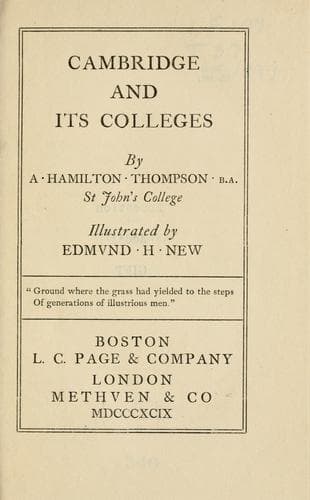
Cambridge and Its CollegesThompson, A. Hamilton (Alexander Hamilton)
History
Cambridge and Its Colleges
Thompson, A. Hamilton (Alexander Hamilton)
University of Cambridge
Pembroke is intimately connected with the revival of learning in England.
Henry VI. contributed generously to the foundation, and practically
set it upon a new footing. Laurence Booth, who became master in 1450
and held the office until his death, was a man of great learning. His
ecclesiastical promotion was rapid; he became Bishop of Durham in
1457, and Archbishop of York in 1476. Thomas Rotherham* succeeded him
as Archbishop of York and Master of Pembroke. Rotherham, whose actual
surname was Scott, was one of the most active promoters of learning in
England. He had previously filled the sees of Rochester and Lincoln, and
was Archbishop of York for twenty-one years. While Bishop of Lincoln,
he had built the east side of the University Library, and he became
the second founder of Lincoln College at Oxford. As Lord Chancellor of
England, his political career was stormy. Fuller, in speaking of his
library at Pembroke, says “Many have mistaken this for the performance of
Richard the Third, merely because his Crest the _Boar_ is set up therein.
Whereas the truth is that _Rotheram_ having felt the sharp Tuskes of
that _Boar_ (when imprisoned by the aforesaid King for resigning the
Great Seal of England to Queen Elizabeth, the relict of King Edward the
Fourth) advanced his arms thereon that he might ingratiate himself.”
Rotherham fell on more peaceful days when Henry VII. came to the throne.
He resigned the mastership in 1488, and died of the plague at Cawood in
1501.
Curiously enough, the next master but two, Richard Foxe (* copy of Oxford
pictures) founded Corpus Christi College at Oxford, just as Rotherham
had re-founded Lincoln. He was at that time Master of Pembroke and
Bishop of Winchester. Foxe was one of the greatest prelates of that
great age. His benefactions to learning were innumerable and priceless;
three colleges at Oxford and three at Cambridge count him among their
benefactors; his splendid chantry at Winchester, one of the finest pieces
of Renaissance sculpture which we possess, is entirely characteristic
of this princely ecclesiastic. His enlightened religious views made him
the friend and patron of the great scholars who flourished during the
reign of Henry VII. He was also remarkable for his political activity;
he was the chief agent in the establishment of the Tudor dynasty,
and was one of the supporters of the throne against Perkin Warbeck’s
rebellion. Ford, in his historical drama of _Perkin Warbeck_, drew Foxe’s
character with admirable force. He died in 1528, old and almost blind,
but still retaining all his vigour and adhering to his bishoprick with
great tenacity. Foxe may be regarded as one of our earliest and wisest
Reformers: he died too early for the final quarrel with Rome, but there
can hardly be any doubt that he would have exerted his influence to
prevent a formal breach.
Public-domain text, read in full here on John Shaqi.
Reviews
Reviews
No reviews yet
Be the first to share your thoughts on this work.
Join the Discussion
Join the discussion
Sign in to leave a comment or review.
Sign InorCreate an account