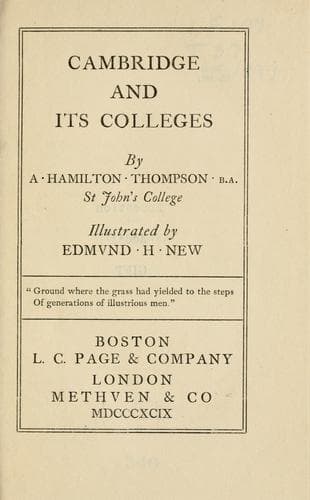
Cambridge and Its CollegesThompson, A. Hamilton (Alexander Hamilton)
History
Cambridge and Its Colleges
Thompson, A. Hamilton (Alexander Hamilton)
University of Cambridge
Dr Caius’ ingenious contention that Cambridge was founded in 3538 B.C.
by Cantaber, a Spanish prince, has never received the support which its
audacity deserves. The town cannot pretend to so great an antiquity, nor
is its Roman origin even certain. It stood in the middle of a country
intersected by Roman lines of road; in no part of England are Roman and
British remains more plentiful and more interesting. The Via Devana,
the great highroad from Colchester to Chester, was the road which runs
through the modern town from the station to Magdalene Bridge, and
continues in a straight line to Godmanchester and Huntingdon. The Via
Iceniana, or Icknield Way, which ran straight across England from the
Eastern Counties, parts company with the Cambridge road on Newmarket
Heath, and pursues an undulating course south-westward to Royston and
Hitchin. Ermine Street, the Old North Road, ran through Caxton, ten
miles west of Cambridge, and met the Via Devana at Huntingdon. At
Gogmagog Hills, five miles out of the town, we can trace the remains of
Vandlebury Camp, which commanded the course of the Roman roads, and
looked over the southern Fens and the Essex border. The familiar name of
Grantchester is certainly of Roman origin. Instances might be multiplied
to show how important this country was to Roman strategy. But there is no
direct evidence to prove that Cambridge of to-day represents the ancient
Camboritum. The Castle Hill, that odd mound from which so good a view of
the town is obtained, is supposed to be in its origin Saxon; it formed
an important outpost against the Danes, who have left so many traces
of their occupation in Norfolk and Suffolk. And the municipal history
of Cambridge certainly begins with Saxon times, and it was the seat of
one of the earliest Gilds. Mr Atkinson, who has so admirably traced the
municipal constitution of the town, gives us some details of the purpose
and form of the Cambridge Gild of Thanes. It was what we should call
to-day a friendly society; its members afforded each other mutual help.
Such Gilds became common in Cambridge as in every town during the Middle
Ages; they were the great aids to municipal life, and we shall find that
some of them grew rich and powerful enough to found a College on their
own account.
Public-domain text, read in full here on John Shaqi.
Reviews
Reviews
No reviews yet
Be the first to share your thoughts on this work.
Join the Discussion
Join the discussion
Sign in to leave a comment or review.
Sign InorCreate an account