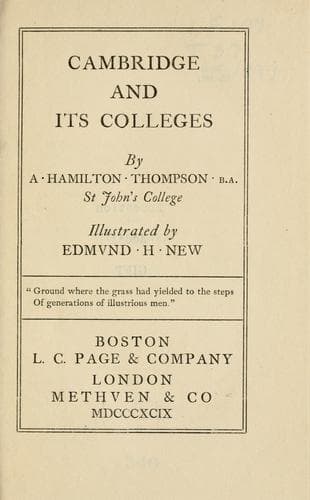
Cambridge and Its CollegesThompson, A. Hamilton (Alexander Hamilton)
History
Cambridge and Its Colleges
Thompson, A. Hamilton (Alexander Hamilton)
University of Cambridge
Our business is, however, with the University. One cannot fix a
deliberate date of foundation. Universities, like every other great
design, have small beginnings, and the origin of schools at Cambridge
was probably insignificant. Cambridge is on the border of the Fenland,
and the Fenland contained the richest abbeys in England. Besides the
great house of Ely, where the bishop was by virtue of his office abbot,
there were, within easy reach of Cambridge, the four Benedictine abbeys
of Peterborough, Ramsey, Thorney and Crowland, all of them in the very
first rank of English houses. Life in the Fens was hard and dismal, and
even Peterborough, the Medehampstead or Goldenburgh of Saxon times, must
have been largely under water for a great part of the year. The towns
on the borders, Cambridge or Stamford, formed an excellent asylum for
those brethren who were too weak to endure the unhealthy mists of the
Nene and Welland Wash. During the middle ages, Cambridge bristled with
small religious houses, cells depending on the greater abbeys; and in
these the young monks of Crowland and the other houses received their
education. This was the beginning of the University. The academic life
was the life of the cloister. The teaching consisted of the ordinary
medieval sciences, Aristotle and the scholastic logic. In after years,
Erasmus deprecated the attachment of Cambridge pedants to Aristotle and
their unreadiness to accept the new learning. Cambridge never was quite
so famous a nursery of schoolmen as Oxford; her history is somewhat more
peaceful. Nor, when the medieval theology fell into discredit, did she
produce a teacher with the European fame of Wyclif. Her history, however,
has a chronology almost parallel with that of Oxford. Out of the monastic
system was evolved the freer life of colleges. Oxford led the way with
University and Merton; Cambridge followed with Peterhouse. The college,
as distinct from the monastery, was a place of retreat whose aim was
learning; the aim of the monastery was self-discipline. It is needless
to say that these colleges were established upon a clerical basis: each
was a society consisting of a master and a certain number of fellows.
Their constitution was that of a public School; the modern undergraduate
system was a much later development. The early founders had no idea of a
college in the modern sense; a society principally composed of laymen,
and a large body of undergraduates who to all intents and purposes are
the College. The one link which connects our colleges of to-day with the
original foundations is the existence of a college chapel, uniting the
various members of the institution for the prime object of the learned
society, the glory of God.
Public-domain text, read in full here on John Shaqi.
Reviews
Reviews
No reviews yet
Be the first to share your thoughts on this work.
Join the Discussion
Join the discussion
Sign in to leave a comment or review.
Sign InorCreate an account