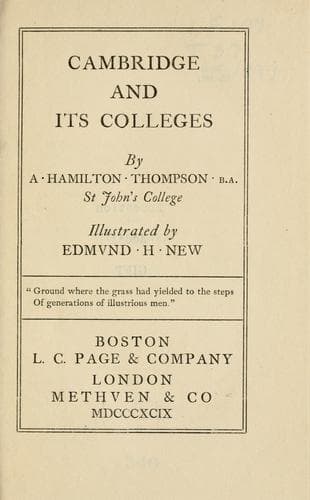
Cambridge and Its CollegesThompson, A. Hamilton (Alexander Hamilton)
History
Cambridge and Its Colleges
Thompson, A. Hamilton (Alexander Hamilton)
University of Cambridge
Passing over the age of Anne and George I. we come to the long mastership
of Dr Roger Long (* Benj. Wilson) who ruled the college from 1733
to 1770. Long became Lowndean Professor of Astronomy in 1750. His
astronomical studies were commemorated at Pembroke by a hollow sphere of
metal, which had a diameter of eighteen feet and was a complete guide to
the solar system. It was contained in a building which terminated the
north side of the second court, but it was destroyed in 1871. Dr Long was
also much interested in the liberal arts; he was a musician and mechanic;
he was also a wit of a not very refined order. His “Musick Speech”
delivered in Great St Mary’s at the Commencement of 1714, is quoted in
Mr J. W. Clark’s book on Cambridge. He was then fellow of his college.
As master, he was a friend of Thomas Gray. When that sensitive poet left
Peterhouse, he met with a royal reception at Pembroke, which proves that
the college was progressive in the direction of culture. Gray joined the
society, and resided in the second court for fifteen years. His rooms
were famous for their comfort in a day when no one thought of furnishing
a room with more than a table and a few chairs, and the blue pots in
his window were the wonder of Cambridge. He was devoted to his adopted
college, and the influence of its structure may be traced in several
passages of his poems. From 1768 to 1771, he held the chair of Modern
History. There are one or two portraits of him in the college. That by
Benjamin Wilson, now in the Combination Room, was painted after his
death. Another poet, his close friend and personal admirer, William Mason
(* Reynolds) belonged to the society for many years, and died in 1797.
If among poets Pembroke claims Spenser, she can also claim William
Pitt among statesmen. There are two portraits of the illustrious Prime
Minister, one, by Harlow, in the Hall; the other, by Gainsborough, in
the Combination Room. Pitt is, however, the property not so much of a
single college as of the University, whose politics have been largely
directed by his memory. His name is preserved in the Pitt Club, which
was established soon after his death and took his coat of arms. It is
to-day the best social club in the University, and has rooms in Jesus
Lane. In later years, Pembroke elected John Couch Adams (* Herkomer), the
discoverer of Neptune, to a fellowship, thus adding to a list which, if
not long, is at least highly distinguished. Under the mastership of Dr
Searle (* Ouless), who was elected in 1880, it has become an exceedingly
popular college, and its numbers are very largely augmented. Dr Edward
Bickersteth, the late Bishop of the Church of England in Japan, was
among the most celebrated of its recent members, and held an Honorary
Fellowship. The present Bishop of Wakefield is the latest addition to its
roll of prelates.
VI
GONVILLE AND CAIUS COLLEGE
Public-domain text, read in full here on John Shaqi.
Reviews
Reviews
No reviews yet
Be the first to share your thoughts on this work.
Join the Discussion
Join the discussion
Sign in to leave a comment or review.
Sign InorCreate an account