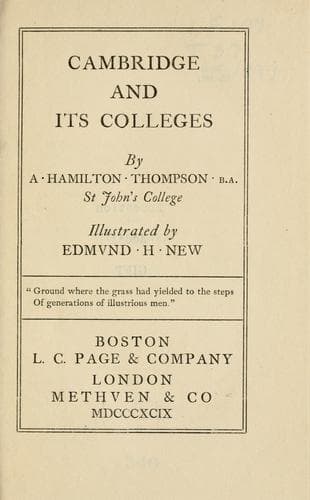
Cambridge and Its CollegesThompson, A. Hamilton (Alexander Hamilton)
History
Cambridge and Its Colleges
Thompson, A. Hamilton (Alexander Hamilton)
University of Cambridge
Whitgift’s mastership, lasting for a few months in 1567, gives another
Archbishop to Pembroke. But he soon left the college for Trinity.
Twenty-two years later, Lancelot Andrewes* became master. As Bishop
successively of Chichester, Ely and Winchester, his name is familiar to
students of the Laudian movement. He was one of those great men who, by
their spirituality rather than their energy, vindicated the Church of
England from Papal claims on one side and from Genevan doctrine on the
other. He is buried, as is well known, in the Collegiate Church of St
Saviour at Southwark. His influence is noticeable in the characters of
his immediate successors. Samuel Harsnet, master from 1605 to 1616, was
also Bishop of Chichester from 1609 to 1619 and of Norwich from 1619 to
1629; and distinguished himself in all these offices by his peaceful and
devout spirit. Nicholas Felton,* Bishop of Bristol, was master from 1616
to 1618, and Bishop of Ely from 1619 to 1628. His next successor but
one, Benjamin Laney,* was a stout Royalist, and was conspicuous for his
fidelity to the exiled King during the Commonwealth. At the Restoration,
he received much recompense. He was made Bishop of Peterborough in 1660,
Bishop of Lincoln in 1663, and Bishop of Ely in 1667. This unique example
of promotion in the Eastern sees closes the list of Pembroke bishops
for some time. Since then, the most famous prelate connected with the
college has been Edward Maltby,* Bishop of Chichester in 1831 and of
Durham from 1836 to 1856. He was the first of the Bishops of Durham
under the regulations by which at the death of Bishop Van Mildert, the
Prince-Bishoprick was finally disestablished.
While these “men of much motion and promotion” were occupying the
mastership of the college, the foundation was not without its famous
sons. They are not, however, very many, and the chief lustre of the
college seems to have found its centre in the master. Richard Crashaw
was in residence here for some time, doubtless attracted by the saintly
fame of the masters of the Stewart epoch. But undoubtedly the greatest
son of the college is Edmund Spenser,* who entered the house probably
during Hutton’s mastership. Of this splendid name Pembroke may well be
proud, although it has no very intimate relation with the life of the
University. Bishop Matthew Wren,* Master of Peterhouse, was a fellow
here. His benefactions are remarkable; they include the fine chapel. He
also bequeathed his silver mitre to the College; and this, although
somewhat ugly in itself, is one of the most valuable pieces of plate in
Cambridge.
Public-domain text, read in full here on John Shaqi.
Reviews
Reviews
No reviews yet
Be the first to share your thoughts on this work.
Join the Discussion
Join the discussion
Sign in to leave a comment or review.
Sign InorCreate an account