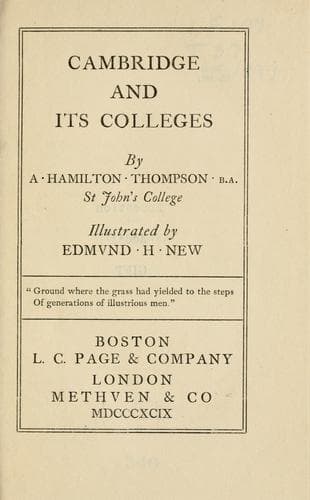
Cambridge and Its CollegesThompson, A. Hamilton (Alexander Hamilton)
History
Cambridge and Its Colleges
Thompson, A. Hamilton (Alexander Hamilton)
University of Cambridge
Very shortly after Marie de Valence had founded Pembroke, Edmund
Gonville, rector of Terrington St Clement’s in Norfolk, founded Gonville
Hall for the instruction of twenty scholars in dialect and other
sciences. He found a site for his hall in what is now Free School Lane,
just behind St Botolph’s Church. The foundation took place in 1348, and,
during Gonville’s lifetime, the name given to the hall was “The Hall of
the Annunciation of the Blessed Virgin.” But Gonville died in 1351, when
his executor, the famous William Bateman, Bishop of Norwich, removed
the buildings and placed them opposite his own college of Trinity Hall.
Henceforward, the college was known as Gonville Hall, and the old name
was retained when Caius re-founded it. The small society—for the college
was at first very poor—took possession of its new tenements in 1353,
when William de Rougham became master. The previous master of the house
in Free School Lane was John Colton, who became Primate of Ireland; and
among the masters of Gonville Hall we find the names of John Rickingale,
Bishop of Chichester in 1426, and John Skippe, Bishop of Hereford in 1539.
It was during the mastership of Skippe’s predecessor, William Bokenham,
that John Caius entered the college as an undergraduate. After he had
taken his degree he was for a few years Principal of Physwick Hostel,
a small house affiliated to Gonville Hall. He left Cambridge, however,
about 1540, and travelled to foreign universities, studying medicine
at Padua and other academies. He was a man of culture, and his taste
was doubtless stimulated by the splendid productions of the Italian
Renaissance. We may, in fact, regard him as one of the greatest English
humanists, and, like so many of them, as one of the greatest benefactors
to his university. On his return to England he practised as a physician,
and received the appointment of court physician to Edward VI. and,
afterwards, to Queen Mary. In 1555, he was elected President of the
College of Physicians. Having thus risen to considerable eminence, he
determined to do something for Gonville Hall. Philip and Mary granted
him letters patent in 1557, with which he refounded the college. In this
way he gave that impetus to medical study which has since made Caius
pre-eminently a doctor’s college. His beautiful buildings are sufficient
testimony to the elegant taste which he had matured in Italy. Thomas
Bacon, master of Gonville Hall and first master of the new foundation,
died in 1559, and the society elected Caius to the mastership. At first
he was reluctant to accept the dignity, and prevailed so far as to refuse
his income as master. His mastership lasted until his death in 1573. He
was one of the most disinterested of all Cambridge benefactors, and his
learning and talents are beyond praise. One odd feature of his career,
which is very characteristic of the uncritical spirit of the time, is
his dispute with Dr Key of Oxford as to the relative antiquity of the
two universities.
Public-domain text, read in full here on John Shaqi.
Reviews
Reviews
No reviews yet
Be the first to share your thoughts on this work.
Join the Discussion
Join the discussion
Sign in to leave a comment or review.
Sign InorCreate an account