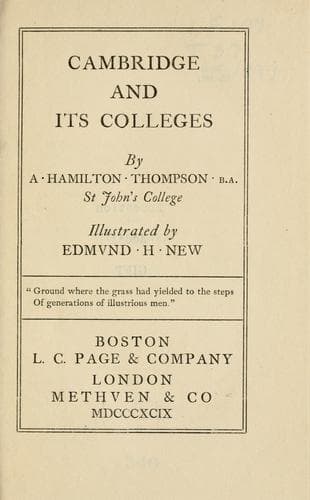
Cambridge and Its CollegesThompson, A. Hamilton (Alexander Hamilton)
History
Cambridge and Its Colleges
Thompson, A. Hamilton (Alexander Hamilton)
University of Cambridge
To some astonishing legend of Key’s, he replied that
Cambridge was founded in the year 3538 B.C. by one Cantaber, a Spanish
prince, alleging many weighty statements on behalf of his accurate
chronology. His _History of Cambridge_ contains more trustworthy
information than this, but he was singularly prone to the acceptation
of spurious etymologies and vain traditions. His contemporaries held
him to be something of an atheist, and complained that he showed “a
perverse stomach to professors of the gospel.” This probably means little
more than that he was content with the old religion. He died away from
Cambridge, but his body was brought from London to be buried. It was met
at Trumpington Ford by the Vice-Chancellor and a procession, who escorted
it into Cambridge with almost royal honours.
Among other gifts to the college, Caius left the silver mace encircled
with serpents, which is called _Caduceus prudentis gubernatoris_. It was
directed to be carried in procession before the master with the _Liber
Cognitionis_ and the _Pulvinar reverentiae_. There are three portraits of
Caius in various parts of the college. That in the Hall, which represents
him holding a pink, is the best.
A notable son of Gonville Hall was Sir Thomas Gresham, well known as
the founder of the Royal Exchange. He died in 1579, so that he had
probably taken his degree before Caius’ time. Caius was succeeded in
the mastership by Dr Legge, a lawyer and Master in Chancery, who was
also Regius Professor of Civil Law. In his day came into residence
William Harvey of Folkestone, one of the great glories of the college.
His discovery of the circulation of the blood created a revolution in
medical science. There are three portraits of Harvey in Caius: one of
them, in the Master’s Lodge, is attributed to Rembrandt; another in the
Combination Room, is a replica of the picture at the Royal College of
Physicians. Another great doctor, John Gostlin,* Regius Professor of
Physic, became master in 1618. He is said to have objected to the wearing
of boots as “more fit for gallants than for civil students.” He also gave
the Bull Inn, which was his property, to Catharine Hall.
Public-domain text, read in full here on John Shaqi.
Reviews
Reviews
No reviews yet
Be the first to share your thoughts on this work.
Join the Discussion
Join the discussion
Sign in to leave a comment or review.
Sign InorCreate an account