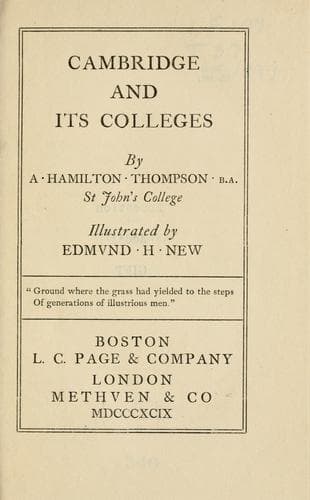
Cambridge and Its CollegesThompson, A. Hamilton (Alexander Hamilton)
History
Cambridge and Its Colleges
Thompson, A. Hamilton (Alexander Hamilton)
University of Cambridge
Canon Law, the typical study of the Middle Ages, is the _raison d’être_
of Trinity Hall. William Bateman, Bishop of Norwich, founded the
College of the Scholars of the Holy Trinity of Norwich in 1350, in
order to furnish his diocese with secular priests. His college occupied
substantially the same ground as it does to-day. The founder, who also
has a claim to be one of the founders of Caius, did not live long to
enjoy his work. He was sent by Edward III. on an embassy to Innocent
VI., in one of the numerous attempts at arbitration which varied the
Hundred Years’ War. While engaged in these negotiations the Bishop died.
His death was due to the climate of Avignon, which, in that season of
plague, was more than ordinarily pestilent. “Avenio ventosa,” says the
doggrel rhyme, “cum vento fastidiosa, sine vento venenosa.” Englishmen,
with their usual mistrust of Papal honesty, said that Bateman had been
poisoned. He left his foundations of Trinity Hall and the new Gonville
Hall in a very incomplete state, and his executor, Archbishop Simon of
Sudbury, although he did what he could in the way of building, was too
much occupied with his fatal position in the state to attend closely
to the condition of the colleges. In fact, Trinity Hall, composed of a
master, twenty fellows and three scholars, was very badly off. Early
in the fifteenth century they complained to Archbishop Arundel of the
insufficiency of their commons, and obtained a dispensation by which
they were empowered to add twopence for each weekday and a groat on the
Lord’s day.
Meanwhile, two of the masters of Trinity Hall are found among the list of
bishops. These were the canonists Robert de Stretton, Bishop of Lichfield
from 1360 to 1386, and Marmaduke Lumley, Bishop of Lincoln from 1450 to
1452. In the year 1525, Stephen Gardiner* became master. He was a native
of Bury St Edmund’s and was a fellow of the college. In 1531, he was
made Bishop of Winchester, but retained the mastership till his death,
esteeming it a refuge to which, in those troublous times, he could always
retire. He was, nevertheless, a little out of his reckoning. Although a
reformer, he was of the conservative type and was not a _persona grata_
to Edward VI., who deprived him of both his mastership and bishoprick.
His supplanter at Winchester was John Poynet; at Trinity Hall he was
superseded by Walter Haddon, reputed to be the best Latinist of his
time. Haddon was Professor of Law and Rhetoric and Public Orator, and,
in addition to this, with the assistance of Sir John Cheke, compiled a
new code of ecclesiastical law. His reforming activities gained him the
Presidency of Magdalen College, Oxford, in 1552, from which he retired at
Queen Mary’s accession. He died some years later and is buried in Christ
Church, Newgate Street.
Public-domain text, read in full here on John Shaqi.
Reviews
Reviews
No reviews yet
Be the first to share your thoughts on this work.
Join the Discussion
Join the discussion
Sign in to leave a comment or review.
Sign InorCreate an account