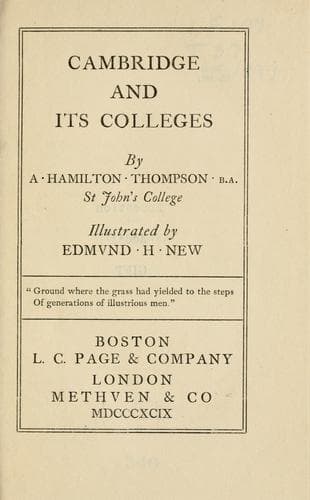
Cambridge and Its CollegesThompson, A. Hamilton (Alexander Hamilton)
History
Cambridge and Its Colleges
Thompson, A. Hamilton (Alexander Hamilton)
University of Cambridge
Mary’s reign brought back Gardiner to his college and diocese. Walter
Mowse, the second Protestant master, was ousted to make way for the
bishop. As Chancellor of England, Gardiner distinguished himself for
his reactionary policy, a natural course in one who, having done all he
could in the way of reform, knew what gratitude he had to expect from the
other side. He died in 1555. There is no doubt that he was an energetic,
pushing man who allowed little to stand in his way, and stories were
told of how he canvassed for the see of Winchester, doing his best to
embitter the last days of Bishop Foxe. He was the bishop who married
Philip of Spain to Mary in Winchester Cathedral; and this, with his acts
of persecution, have endeared him to the orthodox English historian. But
we must make allowance for Protestant hatred, and remember that if such
men as Gardiner, Pole, and Gaspar Contarini had lived a century before,
we should have been spared the irregularities of the Reformation, while
we reaped its advantages. Gardiner’s chantry-chapel is well known to
all visitors of Winchester Cathedral. There are two portraits of him in
Trinity Hall: one in the Combination Room, another in the Master’s Lodge.
A somewhat less single-minded ecclesiastic was Thomas Thirlby,* fellow of
the college, and first and only Bishop of Westminster. He was promoted
in 1550 to Norwich, and to Ely in 1554, when he, too, gained some
reputation as a persecutor of the new religion. Richard Sampson, Bishop
of Lichfield, belongs also to this period.
Henry Hervey, who followed Gardiner, was a great builder, and we owe
the Library to him. From his time onward the college was the legal
centre of Cambridge, and helped to raise English law to a position which
fully realised Bateman’s desire that England should not be “out-lawed”
by other countries. As Canon Law became superseded by Civil Law, the
original purpose of the college and its connexion with Norwich were
quite forgotten. John Cowell, master from 1598 to 1611, was a great foe,
however, to Sir Edward Coke and the common lawyers. His book on the
King’s Prerogative was burned by order of the House of Commons. Another
legal worthy of the time was Sir Robert Naunton, Public Orator, and
author of _Fragmenta Regalia_, who had also some connexion with Trinity
College. He is memorable for an insulting remark which he made to the
Spanish Ambassador, Gondomar, on account of which he was kept a close
prisoner in his own house, stoutly refusing to apologise.
Public-domain text, read in full here on John Shaqi.
Reviews
Reviews
No reviews yet
Be the first to share your thoughts on this work.
Join the Discussion
Join the discussion
Sign in to leave a comment or review.
Sign InorCreate an account