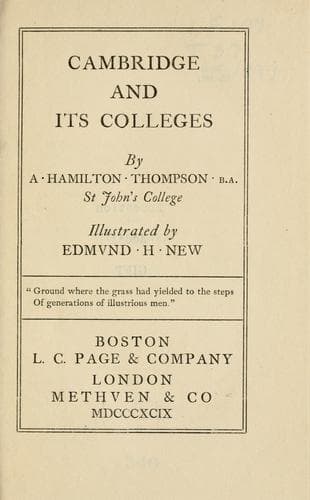
Cambridge and Its CollegesThompson, A. Hamilton (Alexander Hamilton)
History
Cambridge and Its Colleges
Thompson, A. Hamilton (Alexander Hamilton)
University of Cambridge
The Regius Professorship of Civil Law became the practical monopoly of
Trinity Hall in 1666, when Dr John Clark was elected to the office.
It was only on the election of the present Professor Clark that the
succession was broken. Of these professors, one, Dr George Oxenden, held
the mastership and professorship together. Meanwhile, we find one or two
bishops, notably William Barlow, Bishop of Lincoln from 1608 to 1614,
whose name is familiar to controversialists on the subject of Anglican
Orders. The beginning of the eighteenth century produced two more, Adam
Otley, Bishop of St David’s and Richard Reynolds, Bishop of Lincoln.
About the same time, Trinity Hall had the honour of educating Philip
Dormer Stanhope, fourth Earl of Chesterfield (* W. Hoare). It would be
interesting to know more about the life of this celebrated gentleman at
Cambridge, but he doubtless employed his time in picking up miscellaneous
knowledge and laying the foundations of his delightful style. I forgot to
mention that another famous nobleman was a Trinity Hall man—Lord Howard
of Effingham, who commanded the English fleet against the Spanish Armada.
In Nathaniel, Lord Crewe,* Bishop of Durham, the college produced a
devout prelate and Jacobite. He died in his ninetieth year (1633).
Lawyers of the eighteenth century are absolutely innumerable. Sir
Nathaniel Lloyd,* master from 1710 to 1735, was King’s Advocate; his
successor, Sir Edward Simpson,* was Dean of Arches. Sir John Eardley
Wilmot,* Lord Chief Justice of England, was another noted member of the
college. His life nearly spans the last century. Dr John Andrews,* Master
of Faculties, dying in 1747, left the College £20,000, which was to be
paid after the death of his two sisters and expended in building new
wings to the river. Dr Samuel Halifax,* Professor of Law from 1770 to
1782, was clergyman as well as lawyer. Previously, he had held for two
years the two University Professorships of Arabic. His elevation to the
see of Gloucester in 1781 was a suitable reward of such versatility. He
was followed in his Professorship by Dr Joseph Jowett, who made a garden
out of the strip of ground at the angle formed by the outer walls of the
old court and of the principal quadrangle. It faced the lane east of the
cottage, and excited some ridicule. Archdeacon Wrangham’s epigram has
been often quoted:
A little garden little Jowett made
And fenced it with a little palisade;
But when this little garden made a little talk,
He changed it to a little gravel walk.
If you would know the mind of little Jowett,
This little garden don’t a little show it.
The list of legal celebrities in the last century is also adorned by the
name of Lord Mansfield, whose bust, by Nollekens, is in the Hall.
Public-domain text, read in full here on John Shaqi.
Reviews
Reviews
No reviews yet
Be the first to share your thoughts on this work.
Join the Discussion
Join the discussion
Sign in to leave a comment or review.
Sign InorCreate an account