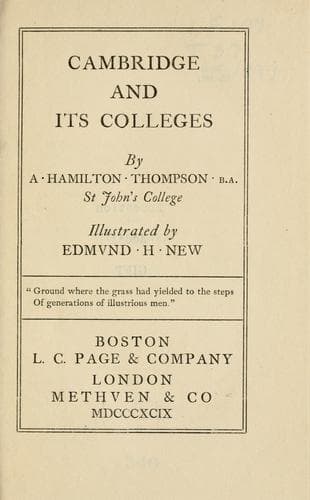
Cambridge and Its CollegesThompson, A. Hamilton (Alexander Hamilton)
History
Cambridge and Its Colleges
Thompson, A. Hamilton (Alexander Hamilton)
University of Cambridge
One of the prettiest spots in the whole University is the tiny medieval
court on the north side of Corpus. You have only to turn your back on the
ugly Hall, and look at three sides of a venerable, low quadrangle clothed
with ivy and stained with age, and you can imagine yourself back in the
days of the Edwards, when the pious members of the Cambridge benefit
societies founded the college. Times have changed, and the court has
been repaired fairly often; but the place retains its medieval flavour.
There is still the gallery which communicated between the college and
St Bene’t’s Church, while St Bene’t’s was the college chapel; with the
aid of a key, you may go straight from under the roof of Corpus into
church, without leaving cover. And, in one corner of the court, the
kitchen, with its great spit revolving in the draught, is a continual
source of interest to all visitors. However, medieval Corpus was never
very conspicuous, and, like most things medieval, it grew incommodious.
Mr William Wilkins, an architect of some knowledge, who had taken his
degree at Caius, was selected in 1823 to renew Corpus in the Gothic
taste, then becoming fashionable. His design, which he executed between
1823 and 1827, was highly praised, and during the next ten years he
left some notable marks of his hand in Cambridge. The great court of
Corpus is a singular instance of the fluctuation of taste. What was then
considered handsome—it was certainly audacious—is to-day an eye-sore. The
proportions of the great court are noble, and everything is conceived on
a grand scale. The Hall and Library are both fine apartments, and the
Chapel is commanding; but the whole building is shallow, and its detail
is flimsy and jejune. All Wilkins’ work, here, at King’s and at Trinity,
deserves careful study; for it shows how the architects of the first half
of the century, with the experience of past ages at their command, failed
even in the elementary matter of imitation.
* * * * *
Public-domain text, read in full here on John Shaqi.
Reviews
Reviews
No reviews yet
Be the first to share your thoughts on this work.
Join the Discussion
Join the discussion
Sign in to leave a comment or review.
Sign InorCreate an account