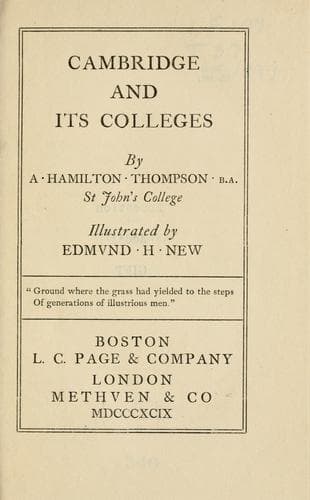
Cambridge and Its CollegesThompson, A. Hamilton (Alexander Hamilton)
History
Cambridge and Its Colleges
Thompson, A. Hamilton (Alexander Hamilton)
University of Cambridge
Corpus has the singular distinction of having been founded by a Gild.
The Gild or Benefit Society was an important institution in medieval
Cambridge, and each church had one attached to it. Somewhere towards
the end of the thirteenth century, when the festival of Corpus Christi
was become a recognised feast of the Church, a society of this kind was
founded in the parish of St Bene’t, and took the title of Corpus Christi
in honour of the Blessed Sacrament. What induced the corporation to found
a college is unknown; its action is at all events a testimony to the love
of learning which was spreading at this time among the middle classes.
In 1352, it obtained a charter from Edward III. for the foundation of
a college. The alderman of the Gild at this date was Henry, Duke of
Lancaster, cousin to the King. One gild, however, was not sufficient to
carry out the work of itself, and the Gild of Corpus Christi achieved
its desire by uniting itself with the Gild of Our Lady, which was
connected with St Mary’s by the Market, the present University Church.
To this union the College owes its coat of arms. In two out of the four
quarters we see the “pelican in her piety,” the emblem of the Blessed
Sacrament; in the other two are the lilies emblematic of the Blessed
Virgin Mary. Another interesting person connected with the foundation
is John Goldcorne, an ex-alderman of the Gild of Corpus Christi. He
had generously given some of his property to Bishop Bateman when the
bishop removed Caius College to its present site. He gave Corpus the
fine drinking-horn which still is the chief piece of plate in the rich
collection belonging to the house. It was probably the horn used at
feasts of the Gild; it is one of the best specimens of the kind in
existence.
Thomas of Eltisley, a village between Cambridge and St Neots, was the
first master. Like most other colleges, its medieval history is not very
extraordinary. Like most other colleges, too, its scholars “kept” their
chapels in a parish church, the adjacent church of St Bene’t. College
and church have always been closely connected, and even to-day, when
the college has ceased to bear its familiar name of Bene’t College, the
advowson of St Bene’t’s is in its gift. In process of time, it built the
south chancel aisle, which it reserved for itself. This was divided into
two stories, an upper and an under, and was entered from the gallery
which still exists between the church and the old court. Finally, in the
sixteenth century, Sir Nicholas Bacon,* the famous Lord Keeper, who had
been educated at Corpus, gave the structure of a chapel. This was built
almost on the site of the present one. It is characteristic of the age
that, to build this chapel, stone was taken from the dissolved abbey of
Thorney and from Barnwell Priory.
Public-domain text, read in full here on John Shaqi.
Reviews
Reviews
No reviews yet
Be the first to share your thoughts on this work.
Join the Discussion
Join the discussion
Sign in to leave a comment or review.
Sign InorCreate an account