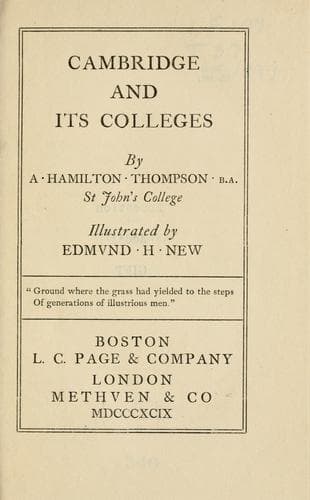
Cambridge and Its CollegesThompson, A. Hamilton (Alexander Hamilton)
History
Cambridge and Its Colleges
Thompson, A. Hamilton (Alexander Hamilton)
University of Cambridge
Although one of the smaller
foundations, its priceless collections give Corpus an importance second
to that of very few colleges, while the unique history of its foundation
singles it out from the rest.
IX
KING’S COLLEGE
Henry VI. is the most famous of the founders of colleges in Cambridge,
but his plan has been adhered to least of all. King’s has gone through
several vicissitudes. The magnificent chapel stood south, not north, of
the original college. That college was to have consisted of four courts;
the fourth was to be on the other side of the river, and a covered
bridge was to lead to it, as to the present fourth court of St John’s.
As at Wykeham’s Oxford College, with which King’s has so many points
of resemblance, the west end of the chapel was to be supplemented with
cloisters and an ample tower. Only one court was built, which now is
part of the University Library. The college has been transferred to the
other side of the chapel, and consists of a scattered series of more or
less modern buildings. From some points of view, the change is to be
regretted, but, had it not been made, we should have lost the unique
view of King’s and Clare from the Backs, which disputes the honours of
Cambridge with the Trinity lime walk.
[Illustration: King’s College]
King’s Chapel was very nearly a century in building. Henry VI. laid its
foundation stone on July 25th, 1446, and the workmen continued at it till
1479 or thereabout. Edward IV. gave £1000 towards it, but the works lay
idle till 1508, when Henry VII. came forward with £5000. Another £5000
was paid over by his executors in 1513, and in 1515 the chapel stood for
the first time as it stands now. The stained glass was added under two
contracts, one bearing date 1516, the second 1526. In 1536 the screen and
most of the stalls were added, and in 1774 Essex spoiled the east end
with some inferior Gothic wood carving, which, fortunately, has lately
been removed.
Public-domain text, read in full here on John Shaqi.
Reviews
Reviews
No reviews yet
Be the first to share your thoughts on this work.
Join the Discussion
Join the discussion
Sign in to leave a comment or review.
Sign InorCreate an account