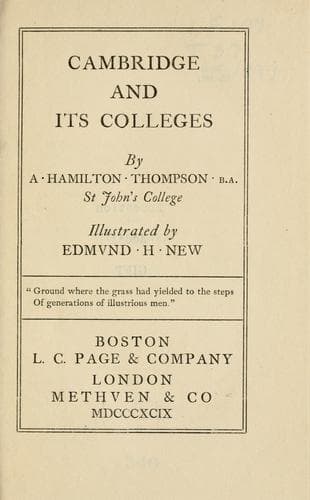
Cambridge and Its CollegesThompson, A. Hamilton (Alexander Hamilton)
History
Cambridge and Its Colleges
Thompson, A. Hamilton (Alexander Hamilton)
University of Cambridge
During the Commonwealth Richard Love* was Master, and was also Dean of
Ely as long as deaneries were suffered to exist. At the Restoration,
Peter Gunning became master for a year, and then passed to St John’s.
Gunning’s part in Church History is well known, and his short residence
may be esteemed an honourable item in the history of the college. Seven
years after his time, another scholar of repute became master, John
Spencer (* Van der Myn), Dean of Ely, and author of a book _De Legibus
Hebraeorum_. Corpus has always been rich in ecclesiastics. It produced
a second Archbishop of Canterbury in Thomas Tenison* who is famous
for his interest in education and his benefactions to schools. In the
next generation another Primate, Thomas Herring,* came from Corpus.
An Archbishop of York belonging to the foundation was Richard Sterne,
afterwards Master of Jesus and grandfather of the great sentimentalist.
Matthias Mawson,* master from 1724 to 1744, was elevated in 1740 to the
Bishoprick of Chichester and translated in 1754 to Ely. On the other
hand, Samuel Wesley was also at Corpus, so that modern Methodism, the
creation of his famous sons, may look with reverence upon the college.
The Master’s Lodge contains a very complete series of portraits, but the
later masters are none of them very noticeable. It cannot be said that
the heads of houses during the early part of the present century were
interesting beings, although they themselves were not without positive
convictions on the point. Dr John Lamb (* Sir W. Beechey), was master
from 1822 to 1850, and supplemented his office with the Deanery of
Bristol. His mastership was signalised by the entire rebuilding of the
college under William Wilkins. Whether the copy of Raffaelle’s School
of Athens (attributed to Poussin) which this radical builder presented
to the college is sufficient compensation for the damage inflicted in
a matter of doubt. The present buildings have nourished some excellent
scholars. Of living celebrities the three brothers Perowne may be
mentioned—Bishop, Master, and Archdeacon. The portrait of Dr E. H.
Perowne in the Hall is by Rudolph Lehmann; that of his brother, the
Bishop of Worcester, is by the Hon. John Collier. The late librarian,
Samuel S. Lewis (* Brock) was a world-wide authority on gems. His
collection, containing many of the finest engraved gems existing, now
belongs to the college, forming a treasure little inferior to Archbishop
Parker’s manuscripts. And, turning to the religious memories of Corpus,
no one who appreciates a life of entire self-sacrifice and devotion will
fail to pay a tribute to the portrait of Thomas Ragland, Fellow of the
College, and missionary to Tinnevelly. It will be seen that the history
of Corpus is throughout almost entirely ecclesiastical, and it is still
a favourite college for undergraduates who wish to proceed to Holy
Orders. Among its latest honours has been the elevation of its librarian,
Dr Harmer, to the Bishoprick of Adelaide.
Public-domain text, read in full here on John Shaqi.
Reviews
Reviews
No reviews yet
Be the first to share your thoughts on this work.
Join the Discussion
Join the discussion
Sign in to leave a comment or review.
Sign InorCreate an account