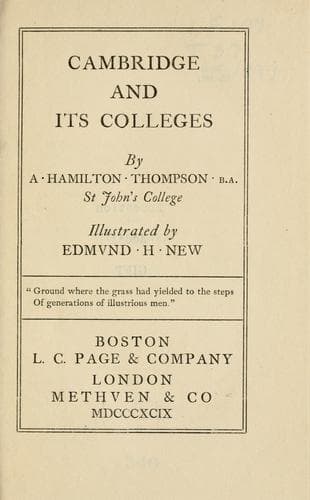
Cambridge and Its CollegesThompson, A. Hamilton (Alexander Hamilton)
History
Cambridge and Its Colleges
Thompson, A. Hamilton (Alexander Hamilton)
University of Cambridge
John Davenant,* president from 1614 to 1622, was, as Bishop of Salisbury,
one of that galaxy of prelates which relieves the darkness of the Civil
Wars. He was the friend of George Herbert, whose parsonage of Bemerton
was within three miles of Salisbury. He died in 1641, before affairs had
come to their final climax. It is probable that he was guilty of some
of those numerous idolatries which Dowsing the iconoclast destroyed on
his visit to Cambridge. Dowsing visited the college on St Stephen’s Day,
1643, when he “beat down 110 superstitious pictures besides Cherubim and
Ingravings,” and “digged up the steps for three hours.” What Dowsing
would say to the internal fittings of the new chapel we have no idea!
After the storm had passed over and the Restoration had given back quiet
to the college, its history languished: and, although it has done well
in the schools, it cannot be said to have produced many men of great
distinction. In Isaac Milner (* Harlow), Dean of Carlisle and President
from 1788 to 1820, it had a Church historian of some reputation. Simon
Patrick,* Bishop of Ely during the reigns of William III. and Queen Anne,
was a fellow here, and was one of the latest survivors of the Laudian
school. His account of the opening of Edward the Confessor’s tomb is
preserved in the University Library in its original manuscript. He was a
great theologian and something of a controversialist. Quite recently the
familiar figure of Dr Campion,* Vicar of St Botolph’s and Honorary Canon
of Ely, and President of Queens’ for the last five years of his life, has
been removed from Cambridge. His successor is Dr Herbert Ryle of King’s,
who holds with the office the Hulsean Professorship of Divinity.
XI
ST CATHARINE’S COLLEGE
It has been said that the decorous quadrangle of St Catharine’s gives
the stranger the impression of an old manor house rather than of a
college; and the trees which guard it on the side of Trumpington Street
are certainly a party to the illusion. The western front of the college,
which occupies one side of King’s Lane, has a more definitely scholastic
air. For the most part the buildings are uninteresting. The tiny court
at the north-west angle dates from 1626; the rest of the college is the
fruit of a rebuilding which went on slowly from 1680 to 1755. Loggan, who
published his illustrations soon after the work was begun, figures, with
some optimism, an eastern façade with a central cupola. This, however,
was never attempted. The chapel is an interesting piece of Queen Anne
architecture, dating from 1704; and lately a fine organ by Norman &
Beard of Norwich has been placed in it. In the present century, the
Hall has been restored in the Gothic style, but otherwise no radical
alteration has been made.
[Illustration: Sᵗ. Catharine’s College]
* * * * *
Public-domain text, read in full here on John Shaqi.
Reviews
Reviews
No reviews yet
Be the first to share your thoughts on this work.
Elsewhere in the archive
Join the Discussion
Join the discussion
Sign in to leave a comment or review.
Sign InorCreate an account