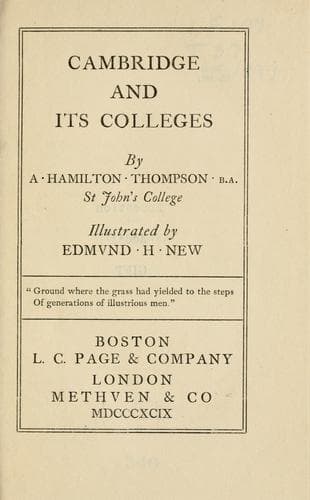
Cambridge and Its CollegesThompson, A. Hamilton (Alexander Hamilton)
History
Cambridge and Its Colleges
Thompson, A. Hamilton (Alexander Hamilton)
University of Cambridge
Another point which the visitor to medieval Cambridge would notice would
be the abundance of religious houses. Great towns, such as London or
Bristol, were well off in this way, but Cambridge could not compare in
size with these cities. There are few of these houses whose remains we
cannot trace in one or other of the colleges. It became, in the fifteenth
century, the fashion to appropriate the monasteries to purposes of
learning. All the great colleges absorbed some of these institutions. The
chief were outside the King’s Ditch. If accounts are true, the monastery
of the Augustinian Canons at Barnwell must have formed a splendid object
in any prospect of Cambridge. To reach it, one would pass through
meadows, with the nunnery of St Mary and St Rhadegund away to the left.
In the southern part of Barnwell, beyond Barnwell Gate, was the house
of Black Friars, on one side of Preachers’ Street, the _faubourg_ which
stretched outside the town boundaries and formed the southern approach to
Cambridge. This friary is now Emmanuel College. Outside Trumpington Gate
was a house of Gilbertine Canons; and opposite it was the house of Friars
of the Sack, which became incorporated with Peterhouse. In Cambridge
itself the Friars were well represented. The Grey Friars occupied the
site of Sidney Sussex College; the White Friars, that picturesque order
which reckoned Elijah as its patriarch, had a house on part of the site
of Queens’ College. The Austin Friars lived on a piece of ground very
nearly corresponding to the University laboratories, which was entered
from Bene’t Street, just where that street meets Peas Hill. All these
friaries were bounded on one side by water: the Carmelite house met the
river; the Franciscan and Augustinian houses abutted on the ditch. Of
these monastic buildings in the town we have scarcely any trace; their
position is merely distinguishable. The Dominican house was swept away by
the founders of Emmanuel, and no one could detect any monastic remains
in the prosaic aspect of that eminently Puritan college. At Jesus,
however, Alcock successfully preserved the plan of the nunnery; and
the college which we see is in substance a monastic building. Barnwell
Priory, with the exception of a small chantry-chapel, has disappeared.
The Augustinian hospital of St John has been blotted out by St John’s
College; its beautiful piscina, incorporated in Sir Gilbert Scott’s
chapel, is its only relic. And, actually, the only building which has
been allowed to stand without alteration is the remote and melancholy
Lepers’ Chapel at Stourbridge, a beautiful Norman building, which was
attached to the Hospital of St Mary Magdalene.
Public-domain text, read in full here on John Shaqi.
Reviews
Reviews
No reviews yet
Be the first to share your thoughts on this work.
Join the Discussion
Join the discussion
Sign in to leave a comment or review.
Sign InorCreate an account