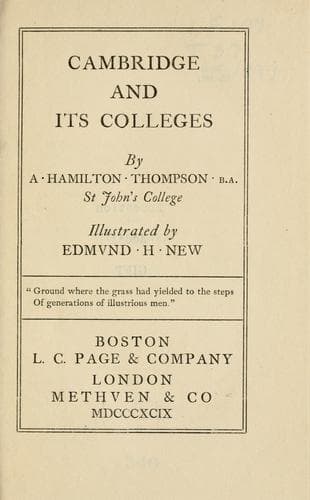
Cambridge and Its CollegesThompson, A. Hamilton (Alexander Hamilton)
History
Cambridge and Its Colleges
Thompson, A. Hamilton (Alexander Hamilton)
University of Cambridge
ST JOHN’S COLLEGE
[Illustration: Sᵗ. John’s]
The first court of St John’s is almost as composite as the Great Court of
Trinity, and the want of harmony between its parts is rather painfully
evident. The chapel, however, is the only important extension of the
original plan as carried out by the Lady Margaret’s executors, and
the rest of the court survives with certain changes. The gateway of
the college is one of the gate-towers so characteristic of Cambridge,
and is perhaps the most beautiful of all. One of the great advantages
of St John’s is that it is built of red brick, which, with time, has
assumed a mellow appearance; and thus it is, in certain respects, one
of the most picturesque colleges in the University. The court and tower
belong to 1520. Above the doorway, on the street side, are the arms of
Lady Margaret, supported by the Beaufort antelopes, on a ground in
which the daisy, the foundress’ punning emblem, occurs very lavishly.
Although much obliterated by time, this is still a very good piece of
heraldic sculpture. Other familiar signs, which the least archæological
undergraduate learns to recognise, are the Tudor rose and Beaufort
portcullis. Above this elaborate armorial display is a figure of St
John the Evangelist, added in 1662. Lady Margaret’s statue is to be
found in an ugly niche over the entrance to the Hall screens; it is in a
pseudo-classical taste, and exaggerates her pious emaciation of feature.
The Hall has been altered a good deal, but it is an interesting
apartment, long, dark and narrow, like a conventual refectory. Its
darkness is due partly to the fine wainscoting, which is of the
linen-pattern, partly to the deep colours of the heraldic windows, whose
interest is historical rather than artistic. The fresco of the upper part
is not very successful. At the end of the hall is a curious portrait of
the foundress, in the manner of Lucas van Heere, which bears comparison
with her picture in Christ’s. She is supported by full-length portraits
of Archbishop Williams and Ralph Hare, benefactors to the college. One of
the most interesting pictures is the well-known portrait of Wordsworth
by Pickersgill; and the modern portrait of Professor Palmer in full Arab
attire (John Collier) usually attracts comment. St John’s Hall is not
rich in portraits, a deficiency which is remedied by the collection at
the Lodge.
[Illustration: Sᵗ. John’s]
Public-domain text, read in full here on John Shaqi.
Reviews
Reviews
No reviews yet
Be the first to share your thoughts on this work.
Elsewhere in the archive
Join the Discussion
Join the discussion
Sign in to leave a comment or review.
Sign InorCreate an account