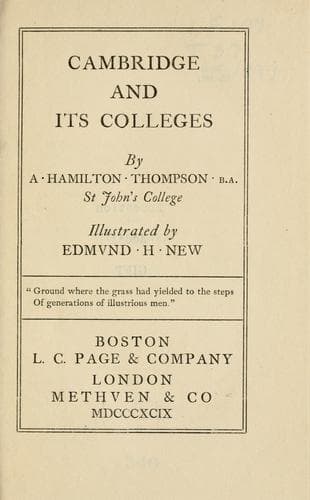
Cambridge and Its CollegesThompson, A. Hamilton (Alexander Hamilton)
History
Cambridge and Its Colleges
Thompson, A. Hamilton (Alexander Hamilton)
University of Cambridge
Lord Powis, High Steward of the University at the
time, gave the windows in the apse, and the rest are in memory of friends
and benefactors of the college. The chapel was consecrated in 1869 by
Dr Harold Browne, then Bishop of Ely. Some of the old stalls from the
original chapel, with their miserere seats, have been kept; and the fine
Early English piscina which belonged to the chapel of St John’s Hospital
has been incorporated in the arcading of the chancel. It belongs to a
local class which includes the piscina at Jesus Chapel and the piscinae
in the transepts at Histon, three miles away. Another relic is the altar
tomb of Hugh Ashton, Archdeacon of York, who was one of the foundress’
executors and died in 1522. The upper portion of the monument is canopied
and richly coloured; the lower part is open and contains the “cadaver,”
which was fashionable with ecclesiastics of the day. Ashton’s rebus,
an ash growing out of a tun, appears in various parts of the base and
canopy. In the antechapel also are Baily’s statue of Dr Wood, Master of
St John’s and Dean of Ely, and the old altar-piece by Raphael Mengs.
Other objects of interest are the paintings on the roof, a procession
of illustrious Churchmen and Churchwomen of every age leading up to the
figure of Our Lord in glory, which occupies the centre panel of the
roof in the apse; the fine organ by Messrs Hill; and the marbles in the
chancel. The chapel is 172 feet long and 63 feet high to the inner roof.
The pitch of the outer roof is 80 feet, and the tower rises to 140 feet.
The Master’s Lodge is a comfortable building, and contains a number of
pictures, including two portraits of Charles I. and Henrietta Maria by
Vandyck, and a large portrait of Matthew Prior (Rigaud) in his official
robes. Since then, the only addition of structural importance to this
interesting college has been the wing known as the Chapel Court, which
runs at right angles to the main building opposite the west door of
the chapel. This was added in 1884, by Mr F. C. Penrose, and is of red
brick with white stone dressings and with a louvre in the centre. The
college grounds have been laid out from time to time, and, with their
winding walks and beautiful Fellow’s Garden, are the most interesting and
romantic of all the gardens near the river.
* * * * *
Public-domain text, read in full here on John Shaqi.
Reviews
Reviews
No reviews yet
Be the first to share your thoughts on this work.
Elsewhere in the archive
Join the Discussion
Join the discussion
Sign in to leave a comment or review.
Sign InorCreate an account