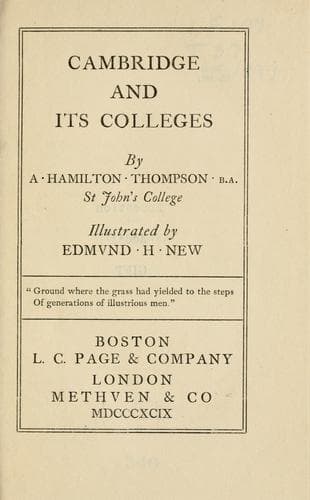
Cambridge and Its CollegesThompson, A. Hamilton (Alexander Hamilton)
History
Cambridge and Its Colleges
Thompson, A. Hamilton (Alexander Hamilton)
University of Cambridge
In founding St John’s College, Lady Margaret Beaufort followed the
precedent of Bishop Alcock. It is curious to observe how the most fervent
Catholics of the Renaissance era subordinated monasticism to the revived
learning and disestablished religious houses on merely nominal pretexts.
The close likeness between the document which explains the dissolution
of St Rhadegund’s Nunnery and that which excused the abolition of St
John’s Hospital detracts from the value of the charges they contain and
leads us to believe that they are merely repetitions of a recognised
form. St John’s Hospital was a small religious alms-house which had
been founded in 1135 by one Henry Frost, and was under the management
of Black Canons. It had a certain importance as being the first site of
Hugh de Balsham’s collegiate scheme. He grafted his scholars upon the
monastic stock, but his plan was anything but a success, and he removed
his _protégés_ to Peterhouse. The hospital was not a very flourishing
affair, and, whether the charges of immorality were true or not, there
was sufficient excuse for its dissolution in the fact that in 1509 it
contained only two brethren. The Lady Margaret, in that same year, the
year of her own and her son’s death, obtained leave to suppress it and
found a college on its site. She had been prompted to this work by her
confessor and faithful adviser, John Fisher, Bishop of Rochester, himself
a man of great distinction in the University, a friend of learned men
and a patron of study. And, although the college is very justly proud of
its royal foundress and shares her coat-of-arms with Christ’s College,
the active part of the work was carried out by Fisher as her executor.
The Charter of foundation was granted by Henry VIII. in 1511, and Fisher
himself consecrated the Chapel in 1516. It follows that, although Fisher
was a member of Queens’ College, his name is connected almost entirely
with St John’s. This close relation of one man to two colleges is clearly
manifested by the likeness which those parts of St John’s built by
Fisher’s instrumentality bear to parts of Queens’ College.
Public-domain text, read in full here on John Shaqi.
Reviews
Reviews
No reviews yet
Be the first to share your thoughts on this work.
Elsewhere in the archive
Join the Discussion
Join the discussion
Sign in to leave a comment or review.
Sign InorCreate an account