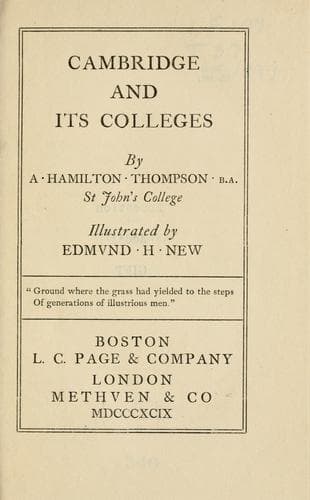
Cambridge and Its CollegesThompson, A. Hamilton (Alexander Hamilton)
History
Cambridge and Its Colleges
Thompson, A. Hamilton (Alexander Hamilton)
University of Cambridge
St John’s College was the last and greatest of the Lady Margaret’s
works. When we think of the benefits which she conferred on Oxford and
Cambridge, her noble provisions for the theological schools of both
Universities, and her two foundations in Cambridge, we can only echo
the words of the funeral sermon preached by Fisher in her honour, that
the “students of both Universities, to whom she was as a mother … for
her death had cause of weeping.” Very few colleges have so tender an
attachment to a founder’s memory as that which St John’s has for Lady
Margaret’s; there are very few colleges which are so haunted, as it were,
by their founder’s spirit. And the history of St John’s is a record
worthy of the Lady Margaret. Although, in after years, it was a little
overshadowed by the greater glory of Trinity, it kept the second place
against all competitors, and its roll of illustrious names is almost as
crowded as that of Trinity itself.
The first master was Robert Shorton, who continued in the college for
five years, after which time he became Master of Pembroke. His portrait
is to be found among the great collection in the Master’s Lodge. The
early masters of the college followed one another very rapidly; in fact,
between 1511 and 1612 we find no less than seventeen names, an almost
unique instance of quick succession. Under the Tudors, too, the college
history is not profoundly interesting. It is evident that, during the
reign of Edward VI., the fashionable Genevan doctrines became popular in
the college. Thomas Leaver, master in 1551, was a supporter of the new
religion, and was, of course, ejected by Mary. However, with Elizabeth’s
reign the Puritan spirit returned in double force. The two Pilkingtons,
who occupied the mastership in succession, introduced their Genevan
and German friends to the Universities, and sought to model University
life upon the system followed by the foreign Calvinists. It is worthy
of remark that while, during this period, Trinity was producing Bacon,
St John’s had already produced the great Burghley, the first of her
illustrious sons, and perhaps the most illustrious of them all. St John’s
became for many years the hereditary college of the Cecil family. The
connection between the college and both branches of that great house is
still kept up in the prize exercise known as the “Burghley Verses,” one
copy of which is sent annually to Hatfield and another to Burghley.[7]
Public-domain text, read in full here on John Shaqi.
Reviews
Reviews
No reviews yet
Be the first to share your thoughts on this work.
Elsewhere in the archive
Join the Discussion
Join the discussion
Sign in to leave a comment or review.
Sign InorCreate an account