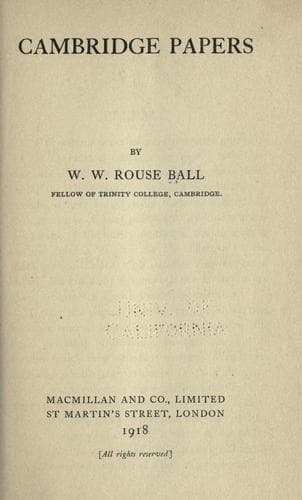
Cambridge PapersBall, W. W. Rouse (Walter William Rouse)
History
Cambridge Papers
Ball, W. W. Rouse (Walter William Rouse)
Trinity College (University of Cambridge); University of Cambridge -- History
Newton's exposition arose from an investigation of the cause of the
motion of the planets round the sun, and this in due course led to the
enunciation and establishment of the Newtonian theory of attraction.
The origin of this theory has been often told, but will bear
repetition. The fundamental idea occurred to Newton in 1665 or 1666,
shortly after he had taken his degree at Cambridge, when, as he wrote
later, "I was in the prime, of my age for invention, and minded
Mathematicks and Philosophy more than at any time since." His
reasoning was as follows. He knew that gravity extended to the highest
hills, he saw no reason why it should cease to act at greater heights,
accordingly he believed that it would be found in operation as far as
the moon, and he suspected that it might be the force which retained
that body in its path round the earth.
This hypothesis he verified thus. If a stone is allowed to fall near
the surface of the earth, the attraction of the earth causes it to
move through sixteen feet in one second: also Kepler's Laws, if
accurate and applicable, involve the conclusion that the attraction
of the earth on a distant body varies inversely as the square of its
distance from the earth. Now the radius of the earth and the distance
of the moon were known to Newton, and therefore, on this hypothesis,
he could find the magnitude of the earth's attraction on the moon.
Further, assuming that the moon moved in a circle, he could calculate
the force required to retain it in its orbit. At this time his
estimate of the radius of the earth was inaccurate, and, when he made
the calculation, he found that this force was rather greater than the
earth's attraction on the moon. The discrepancy did not shake his
faith in his theory, but he conjectured that the moon's motion was
also affected by other influences, such for example, as the effect of
a resisting medium which might itself be in motion as supposed by
Descartes in his hypothetical vortices.
Public-domain text, read in full here on John Shaqi.
Reviews
Reviews
No reviews yet
Be the first to share your thoughts on this work.
Elsewhere in the archive
Join the Discussion
Join the discussion
Sign in to leave a comment or review.
Sign InorCreate an account