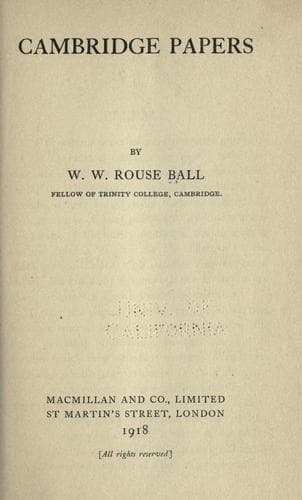
Cambridge PapersBall, W. W. Rouse (Walter William Rouse)
History
Cambridge Papers
Ball, W. W. Rouse (Walter William Rouse)
Trinity College (University of Cambridge); University of Cambridge -- History
In November 1552 the College received the long-expected statutes by
which it was to be governed: with their appearance we leave the field
of conjecture and come to facts. The foundation as here described
included a master, fifty fellows of the standing of master or doctor,
and sixty bachelor and undergraduate scholars: provision was also made
for student-servants or sizars. Vacancies in the roll of scholars were
to be filled by an annual election held at Michaelmas on the result
of a two days' examination. Bachelors of arts and those insane or
suffering from contagious disease (a curious conjunction) were
ineligible: also there could not, at any one time, be more than three
scholars from any one county. The regulation that a bachelor was not
eligible for election to a scholarship suggests that a candidate might
be in residence as an undergraduate, though it does not exclude the
candidature of those who were not already members of the House, but
the custom (if it ever existed) of electing non-residents had died out
before 1560. The admission of pensioners, not exceeding fifty-four in
number, was definitely recognized in 1552: of these the master might
take as his pupils four, and each fellow one. The pensioner which
every fellow might thus receive was in addition to such scholars as
had been assigned to him as pupils, but though scholars had tutors,
the fellow responsible for a pensioner is not explicitly described as
his tutor. It seems that an important part of the duty of a tutor was
to see that all payments due to the college from his pupils were made
punctually. Scholars, unlike pensioners, had definite rights.
The following are some of the regulations:
Public-domain text, read in full here on John Shaqi.
Reviews
Reviews
No reviews yet
Be the first to share your thoughts on this work.
Join the Discussion
Join the discussion
Sign in to leave a comment or review.
Sign InorCreate an account