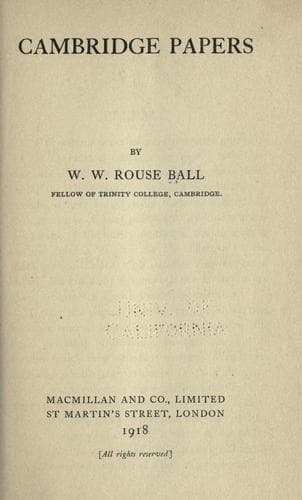
Cambridge PapersBall, W. W. Rouse (Walter William Rouse)
History
Cambridge Papers
Ball, W. W. Rouse (Walter William Rouse)
Trinity College (University of Cambridge); University of Cambridge -- History
This scheme, clumsy and illogical though it was, might have worked
fairly well as long as the great majority of honour men read nothing
but mathematics, classics, and perhaps theology, but it was condemned
by the fact that the authorities allowed it to be superseded in
practice by an elaborate system of private tuition paid for by the
individual students. With the introduction of new subjects (like law,
history, and various branches of science) and the development of the
corresponding triposes, it became necessary to recast the scheme of
teaching if adequate college instruction on such subjects was to be
provided. The earliest appointment of a college lecturer (as
contrasted with an assistant-tutor nominally attached to a particular
side) was made in 1868, his lectures being open to all students of
the Society, and his stipend not charged on the funds of a particular
side. This was soon followed by the placing of all educational
appointments and finance in the hands of the College without regard to
sides; and shortly afterwards the lecture-room accommodation was
considerably extended.
About this time a further step was taken by throwing most of the
advanced lectures open to members of other colleges. Thus in a few
years instruction by tutorial sides was replaced by college lectures
and class-work, and then this, to a large extent, by teaching
organized on a university basis, supplemented by individual and
catechetical instruction in college: with this, the custom of using
private tuition has largely disappeared. Ultimately the title of
assistant-tutor was dropped; the last appointment under that title was
made in 1885, but from about 1870 we may say that practically the
duties of an assistant-tutor were those of a lecturer. Thenceforth
tutors also took their share of lecturing on subjects connected with
their own lines of study, and did not confine their instruction to
their own pupils, though for a year or two lectures on elementary
mathematics and classics to freshmen on each particular side survived
as a historic curiosity. These changes led to the existing scheme
under which tutorial and tuition duties are separated, and thus the
giving of direct instruction to his pupils is not now necessarily
part of the duties of a tutor.
The sequence of tutors on each side has been published, and I am
sorely tempted to add various anecdotes on the way in which some of
these officers fulfilled their duties, but such additions lie outside
the object of this essay.
Public-domain text, read in full here on John Shaqi.
Reviews
Reviews
No reviews yet
Be the first to share your thoughts on this work.
Join the Discussion
Join the discussion
Sign in to leave a comment or review.
Sign InorCreate an account