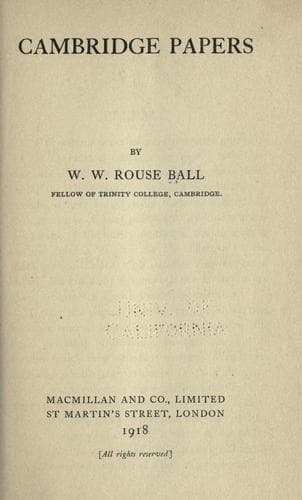
Cambridge PapersBall, W. W. Rouse (Walter William Rouse)
History
Cambridge Papers
Ball, W. W. Rouse (Walter William Rouse)
Trinity College (University of Cambridge); University of Cambridge -- History
Of course during this long period there have been bad as well as good
tutors, but I think everyone will admit that on the whole the system
has worked well. Its special characteristic is a personal relation
between the tutor and the pupil, materially strengthened by constant
intercourse and by the fact that practically all the correspondence
with the parents of the pupil passes through the hands of the tutor:
experience shows that the tutorial influence has not been weakened by
the fact that in most cases direct instruction is now given by other
lecturers.
[Footnote 17: The history of the University prior to 1546 covers some
three centuries and a half, that is, about as long a period as has
elapsed since 1546.]
CHAPTER III.
THE WESTMINSTER SCHOLARS.
The relations between Trinity College and Westminster School have
always been of an intimate character. Under the Elizabethan statutes
of the two foundations a limited number of boys from the school were
entitled, if duly qualified, to election to scholarships at Trinity,
and later an attempt was made to extend the privilege to fellowships.
The whole matter is now one of ancient history, but it may be
interesting to put on record some of the facts connected with it.
The school at Westminster owes its foundation to queen Elizabeth. Of
course the abbey is many centuries older, and in a sense so is the
school, for a grammar-school (in addition to the choir-school) had
been attached to the medieval monastery, though doubtless it existed
only at the pleasure of the monks. When Henry VIII created the diocese
of Westminster with the former abbey as its cathedral, he also
established a school connected with it. The diocese soon disappeared,
and later the church and buildings were given by queen Mary to the
Benedictines. The arrangement made by Mary was in turn annulled by
Elizabeth, who, shortly after her succession founded the collegiate
Church of St Peter, divided into two branches, one ecclesiastical and
the other scholastic, the whole being placed under the rule of the
dean and chapter. Thus Elizabeth is rightly designated as the founder
of the present school, though a link with the past has been preserved
in the fact that the sequence of headmasters dates by custom from
1540. The buildings were divided between the two sides of the College;
for the scholastic side, one part of the monastic dormitory was made
into a school-room, the granary was turned into a school dormitory,
and the boys were allowed the use of the refectory for meals.
Public-domain text, read in full here on John Shaqi.
Reviews
Reviews
No reviews yet
Be the first to share your thoughts on this work.
Join the Discussion
Join the discussion
Sign in to leave a comment or review.
Sign InorCreate an account