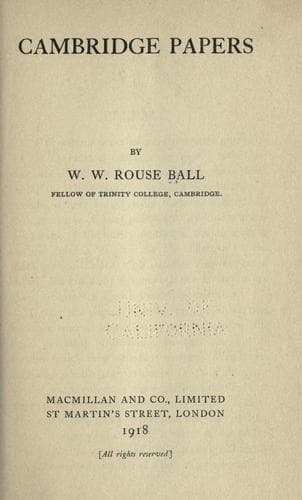
Cambridge PapersBall, W. W. Rouse (Walter William Rouse)
History
Cambridge Papers
Ball, W. W. Rouse (Walter William Rouse)
Trinity College (University of Cambridge); University of Cambridge -- History
There were only forty scholars at Westminster and a provision for the
election from them every year of six scholars to the two universities
was more than ample. Thus in 1561 one scholar was elected to each
university, during each of the six following years, 1562-67, two
scholars were elected to each university, in 1568, six scholars were
for the first time presented, and each university took three. In 1569
the school again presented three boys for election at Trinity, but the
master, Whitgift, refused to elect more than two, alleging that there
were not vacancies in the House for more than that number. Thereon the
scholar or his friends appealed to Sir William Cecil, the chancellor
of the University. Correspondence ensued, but the Society refused to
give way on the particular election. On the general question the
College addressed a letter[18], dated 3 July 1569, to Cecil
entreating him to interpose with the queen to lighten the burden
imposed on Trinity by the royal statutes, and asserting that the
Westminster scholars took up so many places as to act to the detriment
of other and more worthy students. The crown assented to this
proposal, and it was agreed that thenceforth three scholars should be
chosen every third year, and not necessarily more than two in the
other years.
This arrangement lasted but a short time, for a year or two later,
perhaps in 1575, Goodman, dean of Westminster, petitioned[19] the lord
treasurer to confirm or re-enact the original statutes whereby three
Westminster scholars were to be elected each year to each of the two
universities. The petition was granted, and, I conjecture, was the
occasion of the letters patent sent by the queen on 7 February 1576,
to Trinity College, Cambridge, and Christ Church, Oxford, wherein she
repeated and explained her former injunctions. In these letters she
stated that Westminster scholars were not to be allowed to remain at
the school after attaining the age of eighteen, and in regard to their
coming to one of the universities she directed:
Quamvis cupimus plurimos e nostris Discipulis Westmonasterii ad
Academias in dicta Collegia quotannis promoveri, tamen ne incertus
sit omnino numerus, sex ad minimum, videlicet, tres in Ecclesiam
Christi Oxonii et tres in Collegium Trinitatis, singulis annis, si
aut tot loca vacua ... aut tot idonei e nostris Discipulis
Westmonasterii reperti fuerint, admitti volumus; Plures autem
optamus, si ita praefatis Electoribus commodum videbitur.
In fact, however, the former custom of electing three scholars every
third year and two scholars in each of the other years continued until
1588 after which it became usual, though the custom was not
invariable, to elect at least three scholars to each university each
year. During the forty-seven years from 1561 to 1607 inclusive, one
hundred and thirteen scholars in all were elected from Westminster to
Trinity, of whom forty became fellows.
Public-domain text, read in full here on John Shaqi.
Reviews
Reviews
No reviews yet
Be the first to share your thoughts on this work.
Join the Discussion
Join the discussion
Sign in to leave a comment or review.
Sign InorCreate an account