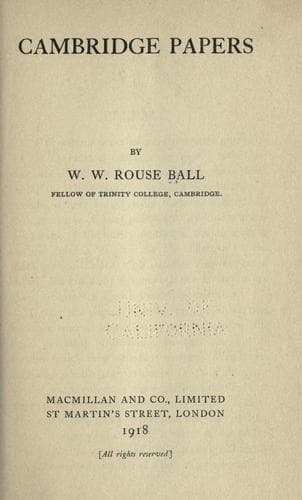
Cambridge PapersBall, W. W. Rouse (Walter William Rouse)
History
Cambridge Papers
Ball, W. W. Rouse (Walter William Rouse)
Trinity College (University of Cambridge); University of Cambridge -- History
The queen interested herself in the school she had established; its
connection with particular colleges at the universities was suggested
by the precedents of Winchester and Eton, and it was natural that she
should desire to associate it closely with the Houses at Cambridge and
Oxford which had been founded by her father. There is some reason to
think that the details of the arrangement made were due to Bill, the
first dean of Westminster, who was at the same time master of Trinity
and provost of Eton; a fortunate pluralist!
On 29 March 1560, Elizabeth gave new statutes to Trinity College,
Cambridge, and in statute 13, dealing with the sixty-two scholars of
the College, she directed as follows:
Sumantur autem potissimum et eligantur ex eorum numero, si modo
idonei et ceteris pares reperiantur qui Schola Regia Westmonasterii
educati ... sint.... Ex aliis regni partibus ac locis indifferenter
ad numerum supplendum qui maxime idonei videbuntur, semper sumantur.
In June 1560, she gave statutes to the Collegiate Church at
Westminster, and in statute 6, dealing with the forty scholars of the
school, she directed that three scholars from the school should be
elected annually to the foundation of Christ Church, Oxford, and three
to that of Trinity College, Cambridge. It is said that the queen did
not ratify these statutes. Be this as it may, in the following year,
on 11 June 1561, she sent to Trinity College letters patent referring
to the Westminster statutes as indicating her wishes in the matter,
and expressing her desire that the Society should select as many
scholars from Westminster as was possible. This then was the position
in 1561, and it was recognised these letters were binding and
conferred rights on duly qualified Westminster scholars.
Throughout the three centuries of the existence of these rights,
candidates usually preferred the Christ Church studentships, which,
being tenable under certain conditions for life, were much more
valuable than Trinity scholarships, since the latter ran out in less
than seven years. Perhaps too the boys were attracted to Christ Church
rather than to Trinity by the fact that there they formed a larger
proportion of the whole Society than in Henry's foundation by the Cam.
Further a boy elected to Christ Church entered sooner into the
emoluments of his studentship than a boy elected to Trinity--the
latter not being admitted to his scholarship until the next annual
election of scholars which took place in the following spring, usually
some six months after he had commenced residence.
Public-domain text, read in full here on John Shaqi.
Reviews
Reviews
No reviews yet
Be the first to share your thoughts on this work.
Join the Discussion
Join the discussion
Sign in to leave a comment or review.
Sign InorCreate an account