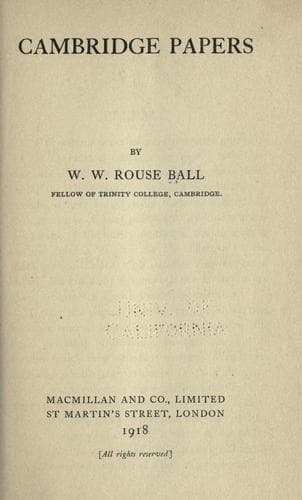
Cambridge PapersBall, W. W. Rouse (Walter William Rouse)
History
Cambridge Papers
Ball, W. W. Rouse (Walter William Rouse)
Trinity College (University of Cambridge); University of Cambridge -- History
At length they went to dinner. After this, a fear having been
expressed, that this "distraction" might become troublesome to their
friends, "perhaps to His Majesty," and "not without some obloquy" to
themselves, the Master of Trinity College proposed a private
settlement, naming October for it. The suggestion was favourably
received by the Electors other than the Dean of Westminster. The
latter however affirmed, that with his consent less than three
Scholars should never be taken by Trinity College and three by
Christ Church if the School produced so many fit Scholars: and as to
that part of the Letters Patent, which related to the election of
Westminster Scholars at Trinity College to Fellowships, he required
that they should be taken in preference to others, if their
qualifications were equal; stating at the same time, that the clause
declaring them eligible to Fellowships two years after their degree
of A.M. had arisen solely from the practice of pre-electing so many
Fellows, that for three or four years together no election took
place; and the Westminster Scholars at Trinity College were driven
out to seek a better fortune elsewhere. The Master of Trinity
College allowed that the practice of pre-elections was wrong; and it
was at length agreed that if this were discontinued, that part of
the King's Letters concerning the eligibility of Westminster
Scholars two years after their degree of A.M. should not be urged
against the local statute of Trinity College, _De Gradibus
Suscipiendis_. Thereupon the Master of Trinity College took for his
College as Scholars three candidates, to wit, Hacket, Shirley, and
Herbert.
The three scholars so taken obtained fellowships in due course, Hacket
became chaplain to James I, Charles I, and later to Charles II,
suffered cruel persecution under the commonwealth, and at the
restoration was made bishop of Lichfield: the Bishop's Hostel was
erected at his cost. An incident in Shirley's career is chronicled
below (see p. 223). Herbert was the well-known poet and divine. If the
above account is reliable, and there is no reason to doubt its
accuracy, the most important question in dispute, namely the
preferential right of Westminsters to election to fellowships at
Trinity, was left open. Nevile however had no intention to allow the
matter to drop, and having made his protest at Westminster, he now
secured the good services of his friend and Cambridge contemporary,
Richard Bancroft, archbishop of Canterbury, who undertook to act as
mediator in drawing up a "friendly and full" settlement of the
question.
Public-domain text, read in full here on John Shaqi.
Reviews
Reviews
No reviews yet
Be the first to share your thoughts on this work.
Join the Discussion
Join the discussion
Sign in to leave a comment or review.
Sign InorCreate an account