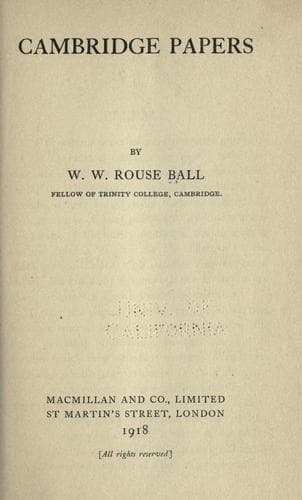
Cambridge PapersBall, W. W. Rouse (Walter William Rouse)
History
Cambridge Papers
Ball, W. W. Rouse (Walter William Rouse)
Trinity College (University of Cambridge); University of Cambridge -- History
An agreement, drafted I feel confident by Nevile, was submitted to the
archbishop and, after he had made a few alterations, was accepted by
the dean and chapter of Westminster. The seniority of Trinity College,
on 5 September 1608, passed a minute that the matter "be referred to
our Master against the 13^th of October," and the deed is so dated,
but its execution must have been delayed since there is a minute of
the seniority, 8 December 1608, ordering that the composition with
Westminster should be engrossed and sealed at the audit so as to be
delivered before 1 February 1609.
The deed embodying this agreement was made between the dean and
chapter of Westminster and Trinity College, and provided that the
College should take yearly three scholars from Westminster School to
be scholars of the College, and that there should be no pre-elections
of supernumerary fellows to the prejudice of the Westminster scholars
if deserving of fellowships. In consideration of these definite
obligations the dean and chapter of Westminster agreed that the
letters patent of 1607 should never be urged against the College by
the dean and chapter or the schoolmaster or ushers or scholars of
Westminster, and that the College should have such full power to elect
fellows as had been previously enjoyed, excepting only the practice of
pre-elections. To the deed is appended a statement that it was made
with the privity and approbation of the archbishop of Canterbury, the
earl of Salisbury (lord high treasurer of England and chancellor of
the University of Cambridge), and of the earl of Northampton (the lord
privy seal), all of whom signed it. This conclusion of the affair may
be regarded as a personal triumph for Nevile.
The arrangement was submitted to the king who in a letter directed to
the College approved it, but required that the Westminster scholars
each year should be granted seniority over other scholars of Trinity
of their year and not be hindered by pre-elections: he did not however
withdraw or rescind the previous letters patent. I have never seen the
text of this letter but its contents are indisputable, and there are
various subsequent references to it. The obligation to allow this
seniority to the Westminster scholars was henceforth recognized by the
College as binding on it.
Public-domain text, read in full here on John Shaqi.
Reviews
Reviews
No reviews yet
Be the first to share your thoughts on this work.
Join the Discussion
Join the discussion
Sign in to leave a comment or review.
Sign InorCreate an account