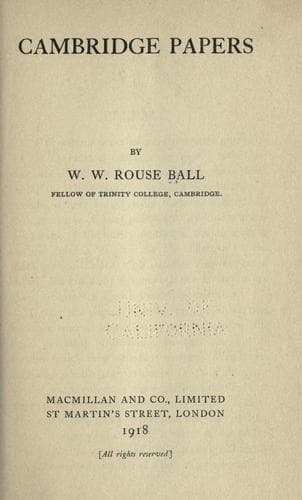
Cambridge PapersBall, W. W. Rouse (Walter William Rouse)
History
Cambridge Papers
Ball, W. W. Rouse (Walter William Rouse)
Trinity College (University of Cambridge); University of Cambridge -- History
The advisers of Trinity seem to have been doubtful whether it would be
admitted that this second letter implied the rescission of the letters
of 1607, and since there was every reason to avoid raising the
question whether royal letters or mandates could be set aside or
modified by private arrangements, it was wise to let matters run on as
long as the agreement of 1608 was carried out by the school
authorities. There is however a memorandum, ascribed to January 1610
in the State Papers, showing that "the recent grant by the King for
the students of Trinity College, Cambridge, to be chosen from the
Westminster scholars is prejudicial to the interests of Trinity,"
which seems to imply that further negotiations took place. I have not
seen the memorandum and know nothing more about this than here
appears.
During the sixteen years following this settlement, that is, from 1608
to 1623 inclusive, fifty-eight scholars were elected from Westminster
to Trinity, of whom sixteen became fellows.
In 1623-24 a fresh dispute occurred. It would appear that while
Trinity carried out its undertaking relating to the election of
scholars from Westminster, it again began to pre-elect fellows with
the object, it was said, of preventing any claim being made on behalf
of the Westminster scholars in residence. Whether this was done in
self-protection against unjustifiable claims or was a deliberate
breach of the agreement of 1608 we do not know. An appeal to the crown
on behalf of the school ensued, and on 7 September 1623, the king sent
letters patent to the College as follows:
Trusty and well beloved we greet you well. Being much interested in
the prosperity and well-fare of that our College which is both our
immediate Foundation and the fairest in all our kingdoms, and
furnished, for the most part with the extracions of our own
free-school at Westminster, we cannot but be very sensible of any
alteration in the government of the same.
Public-domain text, read in full here on John Shaqi.
Reviews
Reviews
No reviews yet
Be the first to share your thoughts on this work.
Join the Discussion
Join the discussion
Sign in to leave a comment or review.
Sign InorCreate an account