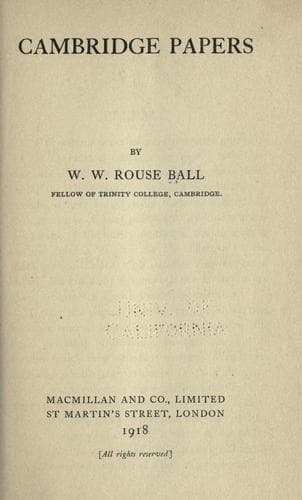
Cambridge PapersBall, W. W. Rouse (Walter William Rouse)
History
Cambridge Papers
Ball, W. W. Rouse (Walter William Rouse)
Trinity College (University of Cambridge); University of Cambridge -- History
our own, for after his writing he would force us no further. With
which words we were well armed, and so departed.
This important interview was followed by a rumour that it was Henry's
intention to found at Cambridge a new and magnificent college to serve
as an enduring record of his interest in learning, and perhaps the
University may have taken the queen's letter as indicating what was
coming. It is believed that Henry had long entertained vague ideas of
the kind, but that the definite suggestion, which was encouraged by
the queen, originated with Redman, who, as royal chaplain, had
constant access to the king and considerable influence with him.
The preparations for Henry's proposed foundation were made with
extreme speed: a wise course in view of his failing health and
variable temper. It was decided to take advantage of the Act of 1544
and suppress King's Hall and Michael-House, using their grounds and
adjoining property as the site of the new college. We have no
reference to the appointment of commissioners for the business, though
there is an allusion, quoted later, to receivers: perhaps the matter
was left in the hands of the officials of the Court of Augmentations.
Redman was the chief authority at Cambridge in the arrangements that
had to be made there, and it was intended that he should be the first
master of the new college when it was founded.
The two Societies above mentioned were (save for Peterhouse) the
oldest in the University. To Trinity men their history has, naturally,
great interest, and I interpolate a few remarks on this and their
position in 1546.
The King's Scholars, normally thirty-two in number and of all ages
from fourteen upwards, were established by Edward II under a warden in
1317 and incorporated in 1337. They had for their original home a
large house (King's Hall) situated on the grass plot and walk in front
of the present chapel, and rapidly acquired all the adjacent land
between the High Street (now known as Trinity Street) and the river,
extending their buildings in various directions. Popular writers
sometimes assert or assume that all medieval colleges were founded for
poor students. That is not universally true. No condition of poverty
was imposed on the scholars of King's Hall, nor was their life here
penurious: they had a dining-hall, library, common room, chapel,
kitchens, a brewery, a vineyard, a garden, and a staff of servants
maintained by the Society, while a good many of them also kept their
own private servants: they received a liberal allowance for daily
commons, clothes and bedding were supplied from the royal wardrobe,
and pocket-money was given to buy other things. They were appointed
by the crown largely from among the families of court officials,
nominations being restricted to those who knew Latin. After completing
their course many of these students entered what we may call the
higher civil service of the time in church or state.
Public-domain text, read in full here on John Shaqi.
Reviews
Reviews
No reviews yet
Be the first to share your thoughts on this work.
Join the Discussion
Join the discussion
Sign in to leave a comment or review.
Sign InorCreate an account