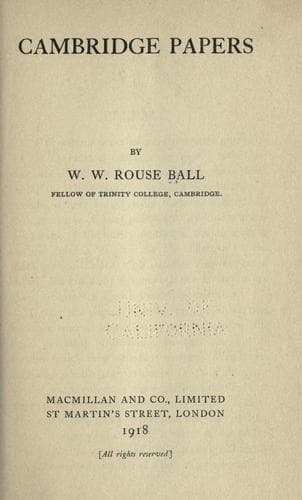
Cambridge PapersBall, W. W. Rouse (Walter William Rouse)
History
Cambridge Papers
Ball, W. W. Rouse (Walter William Rouse)
Trinity College (University of Cambridge); University of Cambridge -- History
In the report of the commissioners, the annual income of King's Hall
was returned as £214. 0s. 3d. and the expenses as £263. 16s. 7d.; and
it was stated that at the time there were on its boards, a master,
twenty-five graduate fellows, and seven undergraduate fellows,
besides servants. The Society owned the patronage of the livings of
Arrington, Bottisham, St Mary's Cambridge, Chesterton, Fakenham,
Felmersham, and Grendon. According to the return, the normal annual
expenditure of King's Hall, if all the scholars resided, required
£182. 18s. 4d. for the emoluments of the warden and fellows (namely,
£8. 13s. 4d. for the warden, £5. 10s. 0d. for each of twenty-five
graduate fellows, and £5. 5s. 0d. for each of seven undergraduate
fellows); £32. 2s. 0d. for the college servants (namely, the butler,
barber, baker, brewer, laundress, cook, under-cook, and the warden's
servant); £3. 1s. 4d. for the estate officers and quit-rents; £3. 19s.
4d. for the expenses of the chapel services and the bible-clerk; £5.
0s. 0d. for firing for the hall and kitchen; £5. 0s. 0d. for rushes
for the hall; £5. 10s. 4d. for the exequies of the founder and the
following refections; £29. 1s. 4d. for repairs and renewals; and £10
for extraordinary expenses.
The other College (Michael-House) whose buildings were transferred to
Trinity was of a different type. It was founded by Hervey de Stanton
in 1324 for a master and six secular clergy who wished to study in the
University. Their original home was a large house on the site of the
present combination room and the land round it; later they acquired
all the property between Foul Lane and the river. At first the
Society's means were barely sufficient for its needs, but in time it
received many gifts, and the foundation was increased to a master and
eight priests with chaplains and bible-clerks. It had an oratory in
its House but did not need a chapel as it owned St Michael's Church;
traces of this ownership will be noticed in the arrangement for stalls
(to be occupied by members of the Society) in the choir, which is sunk
below the level of the nave and chancel.
Public-domain text, read in full here on John Shaqi.
Reviews
Reviews
No reviews yet
Be the first to share your thoughts on this work.
Join the Discussion
Join the discussion
Sign in to leave a comment or review.
Sign InorCreate an account