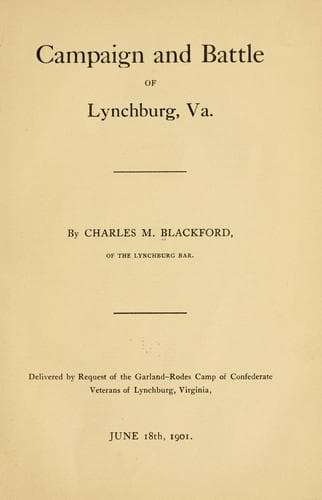
Campaign and battle of Lynchburg, Va.Blackford, Charles Minor
History
Campaign and battle of Lynchburg, Va.
Blackford, Charles Minor
Lynchburg (Va.) -- History -- Civil War, 1861-1865; Lynchburg, Battle of, Lynchburg, Va., 1864
[Illustration: BRIGADIER-GENERAL JOHN McCAUSLAND.
FROM A PHOTOGRAPH TAKEN IN LYNCHBURG DURING THE WAR.]
Campaign and Battle
OF
Lynchburg, Va.
By CHARLES M. BLACKFORD,
OF THE LYNCHBURG BAR.
Delivered by Request of the Garland-Rodes Camp of Confederate
Veterans of Lynchburg, Virginia,
JUNE 18th, 1901.
PRESS OF
J.P. BELL COMPANY,
LYNCHBURG, VA.
PREFACE.
During the winter of 1901, the Garland-Rodes Camp of Confederate
Veterans of the City of Lynchburg passed a resolution requesting
their comrade, Captain Chas. M. Blackford, of Company B, Second
Virginia Cavalry, C.S.A., to prepare an address upon the Campaign and
Battle of Lynchburg, which was to be delivered on June 18, 1901, the
thirty-seventh anniversary of the events of which he was to speak.
Captain Blackford consented to do this work, and did it so much to the
satisfaction of the Camp that it ordered his address to be printed as
a valuable contribution to the history of the war and the traditions
of our city. It is now presented to our citizens and to all who are
interested in the details of our great struggle.
The Committee have also added, as a matter of local history, a roster
of the various volunteer companies which left here when the war
commenced. Many names were added afterwards, but it is to be regretted
that the list cannot be perfected.
Jno. H. Lewis, Chairman,
N.J. Floyd,
R.H. Boatwright,
W. Barbour Jones,
H. Grey Latham,
Committee.
_December 10, 1901._
The Campaign and Battle of Lynchburg.
The strategic importance of the city of Lynchburg was very little
understood by those directing the military movements of the Federal
armies during the Civil War, or, if understood, there was much lack of
nerve in the endeavor to seize it.
It was the depot for the Army of Northern Virginia for all commissary
and quartermaster stores gathered from the productive territory lying
between it and Knoxville, Tennessee, and from all the country tributary
to, and drained by, the Virginia & Tennessee Railroad. Here, also, were
stored many of the scant medical supplies of the Confederacy, and here
many hospitals gave accommodation to the sick and wounded from the
martial lines north and east of it. Lynchburg was, in addition, the
key to the inside line of communication which enabled the Confederate
troops to be moved from our northern to our eastern lines of defence,
without exciting the attention of the enemy.
Under these circumstances, it can well be understood that the
Confederate authorities were ever on the alert to guard so important
a post. They relied, however, on the facility with which its
garrison could be reinforced, when threatened, and not on an army of
occupation, for it could not afford to keep so many troops idle.
Though equally important to the success of the Northern armies, in
their operations in Virginia, no serious effort was directed against it
until the spring of 1864.
Public-domain text, read in full here on John Shaqi.
Reviews
Reviews
No reviews yet
Be the first to share your thoughts on this work.
Join the Discussion
Join the discussion
Sign in to leave a comment or review.
Sign InorCreate an account