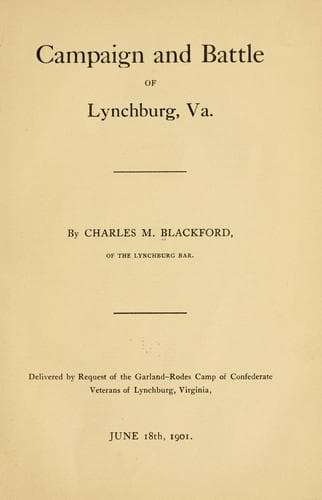
Campaign and battle of Lynchburg, Va.Blackford, Charles Minor
History
Campaign and battle of Lynchburg, Va.
Blackford, Charles Minor
Lynchburg (Va.) -- History -- Civil War, 1861-1865; Lynchburg, Battle of, Lynchburg, Va., 1864
This affair closed about two p.m. From prisoners captured
we obtained positive information that a portion of Ewell's corps was
engaged in the action, and that the whole corps, twenty thousand
strong, under the command of Lieutenant General Early, was either
already in Lynchburg or near at hand. The detachment sent by General
Averell to operate on our right had returned, reporting that they
had encountered a large body of rebel cavalry in that quarter, while
Duffie, although holding his position, sent word that he was pressed
by a superior force. It had now become sufficiently evident that
the enemy had concentrated a force of at least double the numerical
strength of mine, and what added to the gravity of the situation
was the fact that my troops had scarcely enough of ammunition left
to sustain another well-contested battle. I immediately ordered all
the baggage and supply trains to retire by the Bedford turnpike, and
made preparation to withdraw the army as soon as it should become
sufficiently dark to conceal the movement from the enemy. Meanwhile,
as there still remained five hours of daylight, they were ordered to
maintain a firm front, and with skirmishers to press the enemy's lines
at all points. I have since learned that Early's whole force was up in
time to have made a general attack on the same afternoon (18th)--an
attack which under the circumstances would probably have been fatal to
us; but, rendered cautious by the bloody repulse of Breckinridge, and
deceived by the firm attitude of my command, he devoted the afternoon
to refreshment and repose, expecting to strike a decisive blow on
the following morning. As soon as it became dark I quietly withdrew
my whole force, leaving a line of pickets close to the enemy, with
orders to remain until twelve o'clock (midnight), and then follow the
main body. This was successfully accomplished without loss of men or
material, excepting only a few wounded who were left in a temporary
hospital by mistake."
By a critical examination and comparison of these reports it will be
seen that the men who did the fighting say nothing of the Confederate
force being "disgracefully routed," or of their "overwhelming numbers,"
and maintain a prudent silence as to the cause of Hunter's withdrawal.
No one can read the whole correspondence without being satisfied that
such men as Averell, Crook, Sullivan and Hayes, who seemed to have
all been gallant soldiers, were much discouraged and had no faith in
Hunter. They believed they could have forced their way through our
lines and were anxious to do so, for they knew that they had force
superior both in numbers and equipment. Believing this, they were
chagrined that a retreat was ordered just as victory was apparently
within their grasp.
Public-domain text, read in full here on John Shaqi.
Reviews
Reviews
No reviews yet
Be the first to share your thoughts on this work.
Join the Discussion
Join the discussion
Sign in to leave a comment or review.
Sign InorCreate an account