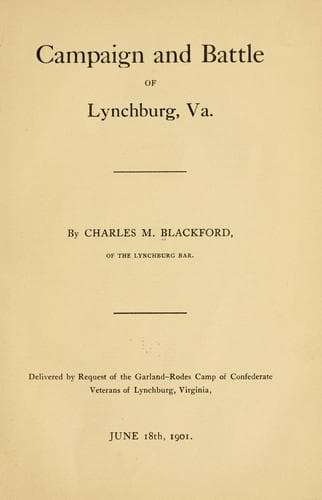
Campaign and battle of Lynchburg, Va.Blackford, Charles Minor
History
Campaign and battle of Lynchburg, Va.
Blackford, Charles Minor
Lynchburg (Va.) -- History -- Civil War, 1861-1865; Lynchburg, Battle of, Lynchburg, Va., 1864
He says in his report, after giving the detail of his performance
there, "I delayed one day in Lexington" (70 W. of R. 97). Colonel Hayes
says _two_ days. (Id. 122.) Had he marched without delay he would
have been in Lynchburg before Early or any part of his troops left
Charlottesville, and the town would have surrendered without firing a
gun. He delayed at Lexington that he might vent his personal ill-will
upon the State of Virginia. He says in his report that he ordered the
Virginia Military Institute, a college for the education of youth,
to be burned, and that he also ordered the burning of the residence
of Hon. John Letcher, formerly Governor of Virginia, alleging as his
reason for this latter act of barbarity that the governor had urged the
people to rise in arms to repel the invasion. In burning both places he
gave no time for anything to be saved. The family of Governor Letcher
barely escaped with the clothes upon their persons, and the torch was
applied to the Institute without the opportunity to save its library,
its philosophical apparatus, its furniture or its archives. All alike
were consumed to appease his vindictive spite. The statue of the Father
of his Country, belonging to the Institute, was stolen and sent to be
erected upon the grounds at West Point. (Id. 640.) It was returned
after the war.
General Early in his memoirs says:
"The scenes on Hunter's route to Lynchburg were truly heart-rending;
houses had been burned, and helpless women and children left without
shelter. The country had been stripped of provisions and many
families left without a morsel to eat. Furniture and bedding had been
cut to pieces, and old men and women and children robbed of all the
clothing they had except that on their backs. Ladies' trunks had been
rifled and their dresses torn to pieces in mere wantonness; even the
negro girls had lost their little finery.
* * * * *
"Hunter's deeds were those of a malignant and cowardly fanatic, who
was better qualified to make war upon helpless women and children than
upon armed soldiers. The time consumed in the perpetration of these
deeds was the salvation of Lynchburg, with its stores, foundries and
factories, which were so necessary to our army at Richmond."
Public-domain text, read in full here on John Shaqi.
Reviews
Reviews
No reviews yet
Be the first to share your thoughts on this work.
Join the Discussion
Join the discussion
Sign in to leave a comment or review.
Sign InorCreate an account