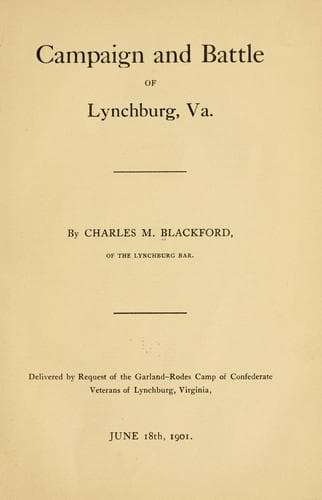
Campaign and battle of Lynchburg, Va. — John Shaqi
Campaign and battle of Lynchburg, Va.Blackford, Charles Minor
History
Campaign and battle of Lynchburg, Va.
Blackford, Charles Minor
Lynchburg (Va.) -- History -- Civil War, 1861-1865; Lynchburg, Battle of, Lynchburg, Va., 1864
There was, however, another more potent influence which stayed Hunter's
advance. General John McCausland had been operating against the enemy
in Southwest Virginia with a body of cavalry. When Hunter reached
Staunton he was ordered across the country to meet him. When near
Staunton, McCausland was joined by a small brigade under the command of
Colonel William E. Peters, now professor of Latin at the University of
Virginia, who was then Colonel of the Twenty-first Virginia Cavalry.
These two brigades, aggregating some sixteen hundred men, under
McCausland's leadership, ably seconded by Peters, at once commenced to
worry Hunter and to keep his whole force in a constant state of alarm.
This force was so ubiquitous that it was estimated by the enemy as
being five times its real size. Amongst the officers in the force under
Colonel Peters was his nephew, and our fellow-citizen, Major Stephen P.
Halsey, who did good service and distinguished himself for his active
gallantry.
As Hunter moved from Staunton to Lynchburg these brigades were ever
in his front, one hour fighting and the next falling back as the main
column would appear, but ever causing delay and apprehension. The
tireless little band performed deeds of gallantry as they hung upon
Hunter's front which entitled every officer and man to a cross of honor.
When Hunter's army reached Buchanan, McCausland had been hovering in
front of his vanguard for many miles. There was a bridge at this point
across James River, over which Hunter expected to cross. McCausland
sent his men over the bridge, and from the south side of the river they
opened fire on the head of Hunter's column as it appeared in sight, and
thus checked their advance. McCausland had caused hay to be piled on
the bridge, much of which was wet with coal oil. He, with Captain St.
Clair, of his command, had remained on the north side for the purpose
of setting fire to the bridge. The Federal cavalry charged up very
close to him before McCausland applied the match, as he was desirous
that every man of his command should get safely over. As fire was
opened on him he applied the torch to the hay, and the coal oil at once
flashed up in a furious blaze.
Captain St. Clair ran up the river bank, and the enemy was so occupied
in the effort to kill him that they did not see McCausland, who escaped
in a small boat under the burning bridge, and was not again under their
fire until he was climbing up the opposite bank of the river.
This thoughtful and gallant conduct of McCausland delayed Hunter's
column for a whole day, thus giving Lynchburg a better chance for
defence and rendering Hunter's raid ineffectual.
Public-domain text, read in full here on John Shaqi.
Reviews
Reviews
No reviews yet
Be the first to share your thoughts on this work.
Join the Discussion
Join the discussion
Sign in to leave a comment or review.
Sign InorCreate an account