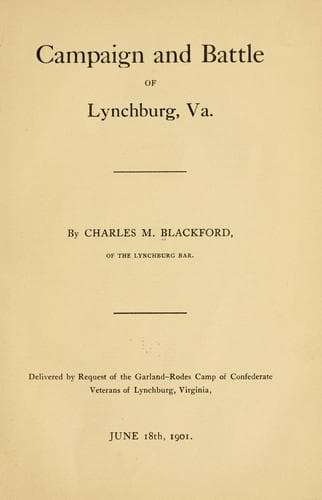
Campaign and battle of Lynchburg, Va.Blackford, Charles Minor
History
Campaign and battle of Lynchburg, Va.
Blackford, Charles Minor
Lynchburg (Va.) -- History -- Civil War, 1861-1865; Lynchburg, Battle of, Lynchburg, Va., 1864
In Early's dispatch reporting the battle at Lynchburg an expression is
used which implies a doubt as to whether the cavalry would do its duty.
Never did cavalry do better service than did that under McCausland,
both as Hunter advanced and as he retreated. Had McCausland had the
full command of the cavalry on the retreat, Hunter's wagon train
and artillery would have fallen into the hands of the Confederates;
but for some reason, which it is now unnecessary to explain, great
opportunities were permitted to pass without advantage being taken
of them. McCausland at Hanging Rock with his force was in a position
to have attacked the retreating column of the enemy and to have cut
off his wagon train and many of his guns. He begged to be allowed to
attack, but was told to await the arrival of the infantry. While he
waited the enemy discovered his position and so far withdrew that when
the inhibition was withdrawn the great opportunity was gone, though,
despite the delay, a number of guns, wagons and supplies were captured
by his force.
During the second day that Hunter was in the lines around Lynchburg
McCausland made a raid around his rear and attacked his train at Forest
Depot, driving a guard of one regiment of infantry and one of cavalry
back to the Salem pike. This gave Hunter much apprehension and threw
his force into confusion; how much it contributed to his rapid flight
that night can never be known. Due credit was not given McCausland for
this, nor for many of his other valuable services.
Lynchburg owes much to Ramseur's division of the Second Corps and to
the men who occupied the lines when Hunter arrived, but it was the
skill of McCausland and Peters and the unflagging energy and courage
of their officers and men, which so retarded Hunter's movements that
when he did arrive there was force enough on our line to prevent his
capturing the city. McCausland and his command were the real saviors of
the city, and some lasting memorial of its gratitude should be erected
to perpetuate their deeds.
McCausland proved himself a soldier of a high type. There were few
officers in either army who, with such a force, could have accomplished
as much. His little command had been in constant contact with the enemy
for many days, had been continuously in the saddle and on exhausting
marches, was badly mounted and badly equipped; everything about it was
worn and weary but their dauntless spirit; that, under the example of
their indomitable leaders, never flagged for an instant. The truth
is, heroism was so common a quality amongst the "old Confeds" during
that war that heroes were almost at a discount and heroic acts passed
unnoticed, however great.
Public-domain text, read in full here on John Shaqi.
Reviews
Reviews
No reviews yet
Be the first to share your thoughts on this work.
Join the Discussion
Join the discussion
Sign in to leave a comment or review.
Sign InorCreate an account