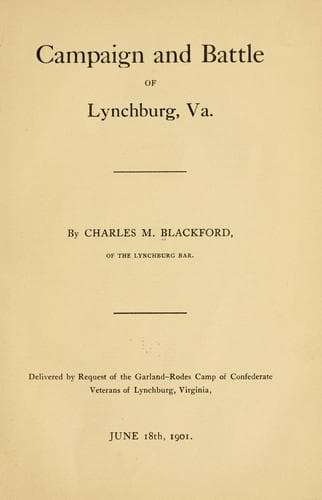
Campaign and battle of Lynchburg, Va. — John Shaqi
Campaign and battle of Lynchburg, Va.Blackford, Charles Minor
History
Campaign and battle of Lynchburg, Va.
Blackford, Charles Minor
Lynchburg (Va.) -- History -- Civil War, 1861-1865; Lynchburg, Battle of, Lynchburg, Va., 1864
The loss on neither side was very heavy, but it was very much greater
on that of the invader than upon ours. Hunter left his dead on the
field to be buried by his enemy, and his wounded in a field hospital;
facts which show how precipitously he departed.
The Federal line of battle was formed on the left, directly through the
yard of the residence of the late C.H. Moorman, whose farm lay on both
sides of Blackwater Creek, and occupied most of what is now called West
Lynchburg. When it was known that Hunter was approaching, Mr. Moorman
packed several wagons with provisions, and, with his negroes and stock,
moved down toward the Staunton River, leaving his house in charge
of his young, unmarried daughter, now Mrs. Hurt, his wife, an old
negro man and several negro women. Before Mr. Moorman cleared his own
plantation, which was large, he found it necessary to lighten his load,
and to that end selected a spot and buried his supply of well-cured and
much prized hams. It turned out that the line of battle of Crook's
division ran across the spot, and the buried treasure was discovered,
much to the delight of the troops, who greatly enjoyed a very fine lot
of old Virginia hams, always valuable, but especially so under such
circumstances.
At sunrise on the morning of the 17th, Miss Moorman went out on a hill
near her house to reconnoitre the military situation. She saw a column
of Federal troops moving on the Salem Turnpike, and was looking at
them very anxiously when she was shocked to see a line of blue coats
crossing the field close to her home. She at once ran back, sheltering
herself behind the fence, but the officer in command was at the door
before she was, and very politely advised her to stay in the house
while the fight was going on. The family were not molested during the
two days that the troops were there. With exceptional visits to the
front yard, she obeyed the officer's instructions very carefully. She
heard the constant cannonading and the picket firing without cessation
all of the 17th and until the evening of the 18th, when the sounds
changed and indicated that a real battle was going on close at hand.
She was naturally in a fever of excitement, but could hear nothing
of the result. About midnight of the 18th, or more probably on the
morning of the 19th, she heard the rumbling of wagons and artillery on
the Salem Turnpike, and found the lines around her house were being
withdrawn, but it was some time before she discovered that the Federal
troops were retreating. It was then nearly daylight, and she slipped
out of the house and ran down to the ford across Blackwater Creek and
notified the cavalry at that point what she had seen. A company was
at once sent off in pursuit to verify her statement. After they had
gone, and as she returned home, she met a solitary Federal soldier on
foot, who asked her what had become of his command. She told him they
had been whipped and had retreated, and informed him that he was her
prisoner.
Public-domain text, read in full here on John Shaqi.
Reviews
Reviews
No reviews yet
Be the first to share your thoughts on this work.
Join the Discussion
Join the discussion
Sign in to leave a comment or review.
Sign InorCreate an account