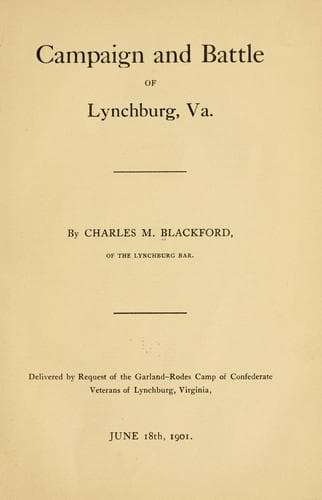
Campaign and battle of Lynchburg, Va. — John Shaqi
Campaign and battle of Lynchburg, Va.Blackford, Charles Minor
History
Campaign and battle of Lynchburg, Va.
Blackford, Charles Minor
Lynchburg (Va.) -- History -- Civil War, 1861-1865; Lynchburg, Battle of, Lynchburg, Va., 1864
War is not a gentle occupation, and its customs are harsh. To make it
effective, it is clearly within the rules of civilization to strip an
enemy's country through which a hostile army is passing of everything
which will sustain the life of either men or beasts. Hence Grant's
historic order about the crow carrying his rations, while cruel, is
within the line of legitimate warfare. But putting non-combatants
to death, insults to women and children, the wanton destruction of
household goods and clothes, the application of the torch to dwellings,
factories and mills, or the destruction of public buildings, and
especially of institutions of learning and their libraries, and works
of art and science, is a style of warfare long since relegated to the
savage. The disgrace of reviving this barbaric strife in modern times
was reserved for Hunter. General Crook, one of his division commanders,
a soldier brave and true, felt constrained to note the conduct of the
troops, and published an order in which he says he "_regrets to learn
of so many acts committed by our troops that are disgraceful to the
command_." Hunter knew all this, but there was no word of protest or
repression from him.
It is to be regretted that later in this campaign, when we carried the
war across the Potomac, some of our troops retaliated for these brutal
acts, upon innocent parties. That Hunter had set the example was no
good excuse, though it was pled. (See General Bradley T. Johnson's
Report, 90 W. of R. 7.)
General Early has been severely criticised for permitting the escape of
Hunter. It is always much easier to criticise than to accomplish; to
point out how a thing should have been done, after we know the result
of what was done, than to do it at the time. The facts heretofore
stated can leave no doubt that all was done, as far as the prompt
pursuit of Hunter is concerned, which could have been done. Early's
line of defence, owing to the smallness of his force, was not only
thin but was short; he had therefore to keep in such a condition that
by changing front rapidly with the troops he had, he could supply the
place of those he did not have. Hence, when he noticed Hunter moving
away from his immediate front, he did not suppose he was retiring,
but merely withdrawing for the purpose of making his attack at another
point, and prudence demanded that he should keep his troops in hand
until the enemy's purpose was developed. To do this the delay until
daylight was essential.
It is a subject of remark that with Hunter's army there were two
men who very faithfully discharged their duties as soldiers and
subsequently became Presidents of the United States--one Colonel
Rutherford B. Hayes, who commanded a brigade, and the other Major
William McKinley, who was a staff officer.
Public-domain text, read in full here on John Shaqi.
Reviews
Reviews
No reviews yet
Be the first to share your thoughts on this work.
Join the Discussion
Join the discussion
Sign in to leave a comment or review.
Sign InorCreate an account