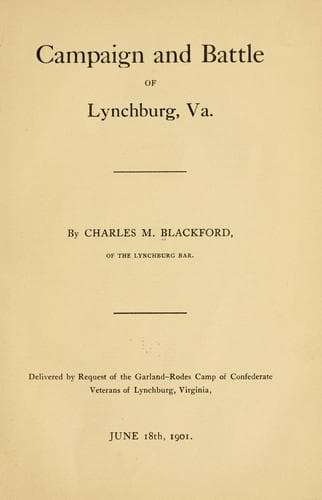
Campaign and battle of Lynchburg, Va. — John Shaqi
Campaign and battle of Lynchburg, Va.Blackford, Charles Minor
History
Campaign and battle of Lynchburg, Va.
Blackford, Charles Minor
Lynchburg (Va.) -- History -- Civil War, 1861-1865; Lynchburg, Battle of, Lynchburg, Va., 1864
"Our people criticise Early with much bitterness for not attacking
Saturday, but I think we ought to be only too glad we got through
safely without the hazard of a battle. Eugene had the headquarters of
his sharpshooters at one time in the cemetery, close by his father's
grave. He went on, of course, with his command. It was a great relief
when we heard that Hunter was gone. Mother stood it remarkably well.
She was, of course, very anxious about Eugene, as she would hear the
booming of the cannon, but she kept up her nerve and spirits.
"Hunter's headquarters were at old Major Hutter's. He told them that
he proposed to capture or burn Lynchburg. Major Hutter was of course,
politely treated while Hunter was there, but after he and some of his
generals who were with him had left the house, other officers and men
robbed it--robbing Miss Hutter's chamber of her clothing and other
valuables. Many wounded were left in Major Hutter's yard; indeed,
the flight was so rapid that all but the slightly wounded were left
behind, together with many small arms and some cannon. Early may
not have done all he might have done, but, certain it is, Hunter's
whole campaign seems to have been a farce. He was gallant when there
was no enemy, and a coward when they were in sight. He burned the
Military Institute, which was not even garrisoned by boys, and set
fire to Governor Letcher's house, which only a woman protected. If the
'bravest are the tenderest,' how true it is that the cowards are the
cruelest. The renegade, David R. Strother (Porte Crayon), was with
Hunter as one of his staff at Major Hutter's. Another traitor to his
State, his name and his race.
"The soldiers who came up with Early gave the most distressing
accounts of the condition of affairs in Louisa County, where the
Yankee raids have done so much harm to the unprotected. They say the
desolation is so great that as they marched through the women and
children flocked to the road for something to eat, and would grasp
eagerly all the bits of cold corn-bread they could spare them from
their haversacks. Is it not horrible to think of?"
A remarkable incident happened in connection with the depredation of
Hunter's troops at Lexington. When the corps of cadets was ordered to
leave the Institution on the approach of Hunter, they deposited their
trunks in the residences of neighboring gentlemen for safe keeping.
Public-domain text, read in full here on John Shaqi.
Reviews
Reviews
No reviews yet
Be the first to share your thoughts on this work.
Join the Discussion
Join the discussion
Sign in to leave a comment or review.
Sign InorCreate an account