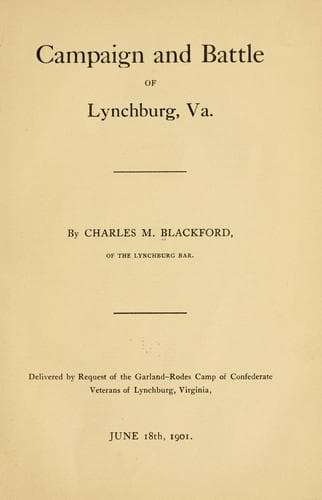
Campaign and battle of Lynchburg, Va.Blackford, Charles Minor
History
Campaign and battle of Lynchburg, Va.
Blackford, Charles Minor
Lynchburg (Va.) -- History -- Civil War, 1861-1865; Lynchburg, Battle of, Lynchburg, Va., 1864
Young Mr. Carter H. Harrison, of Staunton, was then a cadet, and, with
several others, put his trunk at Professor Campbell's to save it. When
the battle was over at Lynchburg and Hunter was gone, the cadets were
not put in the chasing column, but were relieved from further active
duty. Mr. Harrison, with others of the corps, went to the battle-field,
and during his inspection visited the field hospital where the wounded
of the enemy were being cared for by our surgeons. He noticed one man
who was badly wounded in the leg, and whose pantaloons were ripped up
that the surgeon might more easily dress the wound. As Harrison looked
at the soldier he observed his own initials on his socks, and upon
further investigation discovered that all the man's underclothes were
similarly marked and all belonged to him, and were a part of those he
had left in his trunk at Professor Campbell's.
The man confessed that they had looted Professor Campbell's house, and
that the underwear was part of the booty. Arrangements were made by
which possession followed the legal title.
It is needless to attempt to describe the anxiety of the citizens
as Hunter approached, heralded by the accounts of his vandalism at
Lexington and on his march. Until their nerves were restored by the
arrival of Breckinridge's little army of some fifteen hundred men
and the guns of Berkeley and W.S. Lurty's battery, every woman and
non-combatant was actively engaged in hiding silver, jewels, provisions
and other valuables--generally putting them in the very place where
skilled looters would be sure to go in search. Many things were put
away at that time which have never been found since, and never will be.
The anxiety of the hiders so affected their memory that the place of
hiding was forgotten.
As soon as hope was restored by the appearance of additional troops,
the energies of the women were directed to the effort of giving food
to the hungry and travel-worn troops whose arrival had brought them
so much comfort. While the cannon were booming over the hills of the
suburbs and the fierce rattle of contending musketry could be heard,
our women were bending over the fires cooking rations for the men in
the lines, or scraping lint and rolling bandages for the wounded.
The first ray of hope restored confidence, and the inhabitants of
Londondery or Leyden were not more calm or heroic, or more actively
engaged in doing all in their power for defence, than were these women
and the old men, who were the only other inhabitants of the city left.
Public-domain text, read in full here on John Shaqi.
Reviews
Reviews
No reviews yet
Be the first to share your thoughts on this work.
Join the Discussion
Join the discussion
Sign in to leave a comment or review.
Sign InorCreate an account