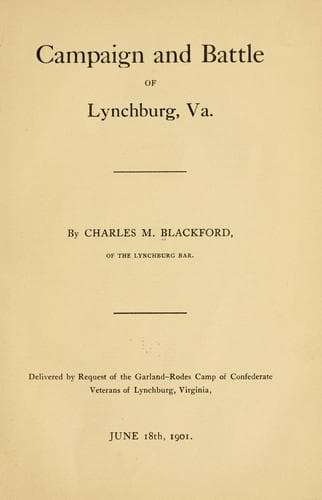
Campaign and battle of Lynchburg, Va.Blackford, Charles Minor
History
Campaign and battle of Lynchburg, Va.
Blackford, Charles Minor
Lynchburg (Va.) -- History -- Civil War, 1861-1865; Lynchburg, Battle of, Lynchburg, Va., 1864
Major-General David Hunter, the commander, was a Southerner by race
and environment, and members of his family had often been honorably
connected with the history of the State of Virginia. He had been an
officer in the United States army, and on the breaking out of the war
between the States, ignored the traditions of his race and took up arms
against Virginia. It is not the custom of those of Virginian blood to
be disloyal to their State, and it is her proud boast that the roll of
those who have been false is very short. What moved Hunter to act as he
did must be developed by his biographer; it is enough for the historian
to record the fact of his apostasy. Most Southern officers in the old
service disapproved the secession of the States, but on the breaking
out of the war, with rare exceptions, they resisted the powerful
temptations held out as inducements to stay and join the Northern
army. They preferred poverty and the uncertainties of the approaching
conflict to a military distinction which could only be won by shedding
the blood of their brothers and friends. With this faith they joined
in the defence of their several States whether they agreed with them
in their political course or not. Such was the course of the Lees and
the Johnsons, of Stuart and the Hugers, of the Maurys, and of hundreds
of others who stood by their people, right or wrong. They believed it
alike the path of duty and of honor to draw their swords in defence of
their native land, in the hour of its greatest need, and they turned a
deaf ear to the whisper of that tempting thrift which is so often the
reward of fawning.
When Hunter and his army were approaching Staunton, a part of his
force, estimated at about eight thousand men, had a battle with a
small, disorganized detachment under General Wm. E. Jones, at a place
called Piedmont, near Port Republic. The troops under Jones were much
worn, and were weary with hard work, sharp fighting and scant rations.
Those of Hunter were fresh, vigorous and well equipped. Jones and his
men fought well, but he was killed early in the action. His death had
a bad effect on his command, and it gave way in much confusion and
with heavy loss. Much good was done during the confusion by Lieutenant
Carter Berkeley and his two ubiquitous guns, which afterwards did such
good service in the lines around Lynchburg and upon Hunter's retreat.
After this disaster, Jones's command, under Vaughan, fell back first
to Fishers ville and Waynesboro, and then towards Charlottesville.
This left the Valley open as far as Buchanan, except for the small,
but ever vigilant force of cavalry, so skillfully and manfully handled
by Brigadier-General John McCausland, who had shortly before been
transferred from the command of an infantry to a cavalry brigade.
Public-domain text, read in full here on John Shaqi.
Reviews
Reviews
No reviews yet
Be the first to share your thoughts on this work.
Join the Discussion
Join the discussion
Sign in to leave a comment or review.
Sign InorCreate an account