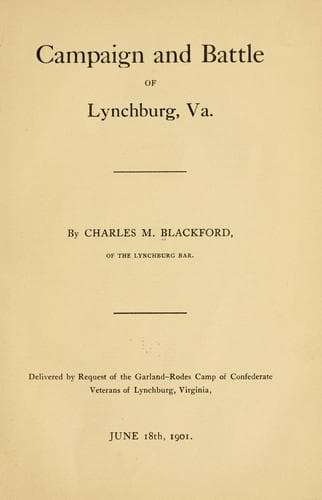
Campaign and battle of Lynchburg, Va.Blackford, Charles Minor
History
Campaign and battle of Lynchburg, Va.
Blackford, Charles Minor
Lynchburg (Va.) -- History -- Civil War, 1861-1865; Lynchburg, Battle of, Lynchburg, Va., 1864
Imboden, with a small body of cavalry, which had escaped from the
battle of Piedmont, and which was badly mounted and equipped, had
crossed the Blue Ridge and was energetically attempting to defend the
Orange & Alexandria Railroad (now the Southern), in Nelson and Amherst
Counties, from a heavy detachment from the column of General Duffie,
sent by Hunter to destroy that road for the purpose of cutting off
reinforcements from Lynchburg.
After the death of General Jones and the defeat of his little army,
Hunter blew his trumpets with boastful triumph. Staunton, of course,
forthwith fell into his hands, which was the occasion for another
blast. General Hunter, in his report of the battle of Piedmont, written
on June 8, says, with pride, that his "combined force, now in fine
spirits and condition, will move, day after to-morrow, toward the
accomplishment of its mission," which was the capture of Lynchburg, and
the destruction of its bridges and stores. (70 W, of R. 95).
The plan of campaign which General Averell had suggested and Hunter
had adopted, was a movement up the Valley to Buchanan in four columns,
each column composed of a division, commanded respectively by himself,
Crook, Sullivan and Duffie. The last-named division was to march in the
same direction on the western slope of the Blue Ridge, sending raiding
parties through the gaps to destroy the Orange & Alexandria Railroad,
and was finally to move through White's Gap to Amherst Courthouse,
whence it was to march toward the James River, cross it below
Lynchburg, cut the James River & Kanawha Canal, destroy the Southside
Railroad, and then move up the river and join in the attack upon the
objective point of the campaign. (70 W. of R. 146).
For the purpose of carrying out this plan, General Hunter left
Staunton on the 10th of June, with his army marching in four columns,
as suggested by Averell. Drums were beating, flags were flying and
triumphant bulletins flashed over the wires to announce to the
Secretary of War the great deeds which were soon to astonish the nation.
* * * * *
On the day Hunter left Staunton with so much pomp and circumstance,
the City of Lynchburg was resting quietly, guarded only by the
convalescents from the hospitals, and the halt and the maimed who were
there congregated in invalid camps. A gallant and appropriate leader
was found for this anomalous force in General Francis T. Nicholls,
who was in command of the post. He had left _a leg and an arm_,
respectively, upon two different battle-fields, but he still managed to
mount his horse and do heroic service. He heard of Hunter's movements
as soon as a start was made, and commenced organizing his sick and
wounded into an army of occupation. From his trenchant dispatches
it seemed that he had determined to hold the town with his cripples
against Hunter's whole force. (70 W. of R. 760).
Public-domain text, read in full here on John Shaqi.
Reviews
Reviews
No reviews yet
Be the first to share your thoughts on this work.
Join the Discussion
Join the discussion
Sign in to leave a comment or review.
Sign InorCreate an account