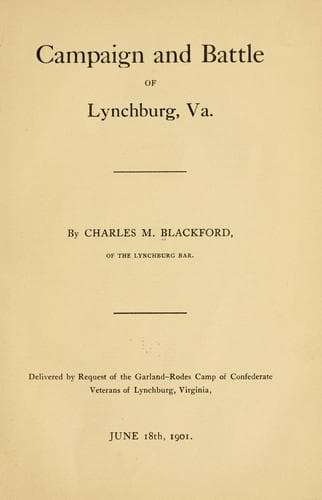
Campaign and battle of Lynchburg, Va.Blackford, Charles Minor
History
Campaign and battle of Lynchburg, Va.
Blackford, Charles Minor
Lynchburg (Va.) -- History -- Civil War, 1861-1865; Lynchburg, Battle of, Lynchburg, Va., 1864
The little remnant of the detachment which had been defeated under
Jones at Piedmont was then along the line of the Orange & Alexandria
Railroad, and near Charlottesville, under General Vaughan, much
demoralized and short of ammunition and supplies. It came by forced
marches, however, to the aid of Lynchburg, where it was under the
immediate orders of General John C. Breckinridge, the commander of the
Confederate Department of Southwest Virginia. Unfortunately General
Breckinridge, though in Lynchburg, was an invalid in bed, having been
injured when his horse was shot under him at Cold Harbor. Some of the
troops which had fought under him around Richmond were _en route_
to the Valley, and, their destination being changed, they reached
Lynchburg before Early's corps, or any part of it, came up.
There was also another small but efficient force which, by almost an
accident, was added to the troops defending Lynchburg. The Botetourt
Artillery, a battery of six guns, under Captain H.C. Douthat, had
been operating in Southwestern Virginia. On the fifth of June it was
ordered to the Valley, _via_ Lynchburg, to the command of General
W.E. Jones. It reached Lynchburg as soon after receiving the order as
transportation could be afforded, and reported to General Jones by the
wires. He directed the battery to remain in Lynchburg until further
orders.
The battery was on the 11th of June ordered to Staunton, and it and its
men, about one hundred in number, were at once put on a freight train
on the Orange & Alexandria Railroad and started, despite rumors of
raiding parties, on its proposed route.
At New Glasgow Station the conductor was notified that a large raiding
party was at Arrington Depot, and the smoke disclosed the fact that the
depot buildings were being destroyed.
Captain Douthat at once pushed forward with the train, upon which
there happened to be a car-load of muskets, with suitable ammunition.
Douthat's object was to reach the Tye River bridge before the Federal
troops and save it from destruction. This he did, and, breaking open
the ordnance boxes, armed his men with muskets and forty rounds of
ammunition, and then, at a double quick, crossed the Tye River, and got
into position to defend the bridge.
When the Federal videttes came in contact with what seemed a heavy
infantry picket they retired and reported a large infantry force on
hand, and the whole raiding party at once withdrew and the bridge
was saved. Had it been destroyed, Lynchburg must have fallen, as
reinforcements could not have come up in time to protect it.
The sound judgment and prompt and bold action of Captain Douthat and
the gallantry of his men on this occasion is worthy of all praise--yet,
strange to say, as he was unattached at the time, there is no official
report of this valuable service.
Public-domain text, read in full here on John Shaqi.
Reviews
Reviews
No reviews yet
Be the first to share your thoughts on this work.
Join the Discussion
Join the discussion
Sign in to leave a comment or review.
Sign InorCreate an account